
Analyzing the American Surveillance State
Understanding the modern American surveillance state requires a specific surveillance state analysis. Rather than a top-down government project, the U.S. developed a surveillance economy. This distinction is crucial for any effective surveillance state analysis, as it highlights a complex network of public agencies and private vendors. This deeply integrated surveillance state architecture is sustained by recurring revenue, entrenched capabilities, and powerful data brokers, making it resistant to simple legislative or judicial reforms.

The Foundations Were Laid Before Most People Were Paying Attention
Mass surveillance did not begin on September 12, 2001. The infrastructure existed before the justification arrived.
During the Cold War and through the 1990s, the United States expanded signals intelligence capabilities through programs operating under the Five Eyes alliance, a formal intelligence-sharing arrangement between the U.S., United Kingdom, Canada, Australia, and New Zealand. The ECHELON program, confirmed through European Parliament investigations conducted between the late 1990s and 2001, gave allied intelligence agencies the technical capacity to intercept civilian communications globally. Satellite interception systems were expanded. Early internet traffic monitoring capabilities were developed. The legal architecture governing these activities was classified, secret, and largely unknown to the public.
Margin Of The Law was founded to make what’s publicly unknown and not discussed to being fully known, understood and discussed.

Post 9/11, The NSA Programs & Federal Collection at Scale
The Department of Homeland Security was created in 2002, consolidating domestic intelligence functions under a broad mandate to prevent threats before they occur. Fusion centers, designed as federal-state-local intelligence sharing hubs, began spreading across the country. Watchlists expanded. Integration of private sector data streams began in earnest.
The clearest window into the scope of federal surveillance came through Edward Snowden’s disclosures in 2013. Three programs illustrate the range and reach of what had been built directly after 9/11.


PRISM
PRISM provided NSA with access to data from major technology companies including Google, Facebook, Apple, Microsoft, and Yahoo. The program allowed collection of email, chat records, video content, stored files, voice communications, and login activity. The companies were served with legal orders; the data moved to government servers.

XKeyscore
XKeyscore provided analysts with a real-time query interface into a massive repository of global internet traffic. Internal NSA training slides, published as part of the Snowden archive, described XKeyscore as the widest-reaching system for developing intelligence from the internet. Analysts could search content and metadata based on email address, name, keyword, phone number, IP address, or other selectors without prior authorization.

Upstream Collection
Upstream Collection involved interception of data directly from the fiber optic cables and infrastructure that carry internet traffic. Unlike PRISM, which collected data from tech companies with legal process, Upstream collection happened at the infrastructure level, capturing internet communications in transit.
The Vendor Layer: Outsourcing Visibility
The federal collection model took a public hit after the Snowden disclosures. What followed was not retrenchment. It was a pivot.
Agencies did not stop wanting mass visibility into people’s activities, associations, and movements. They changed methods. They leaned harder on private contractors, commercial data brokers, local-federal information sharing arrangements, and grant-funded local technology acquisition. The surveillance state became less visibly federal and more operationally networked.
Palantir and the Integration Model
Palantir Technologies is the clearest example of what the public-private convergence looks like in practice, though not the only one. Official federal spending records and procurement notices document Palantir’s extensive role in ICE’s Investigative Case Management system or ICM.
Federal Use of Facial Recognition
In 2021, the Government Accountability Office reported that between April 2018 and March 2020, multiple federal agencies, including the FBI, U.S. Marshals Service, Customs and Border Protection, Secret Service, IRS Criminal Investigation, and Postal Inspection Service, used non-federal facial recognition technology.
The Data Broker Market
In 2024, the Federal Trade Commission announced an order prohibiting X-Mode Social and its successor Outlogic from selling sensitive location data after alleging the company sold precise location information that could be used to track visits to medical facilities, places of worship, and domestic abuse shelters.
Understanding the Foundations of the Surveillance Economy
The most important finding from this investigation is not about any specific program. It is about structure.
The American surveillance state is not held together by a single statute, a single agency, or a single emergency authorization. It is held together by interlocking economic and institutional interests that reinforce each other at every level.
Federal agencies want broad visibility into threats, movements, and networks. Local agencies want tools that expand investigative and enforcement capability. Vendors want recurring government contracts and the data access that comes with them. Grant programs want measurable outputs that justify continued funding. Data brokers want buyers with deep pockets and sustained demand. These interests are not in conflict. They are aligned. And aligned interests produce durable systems.

The American Surveillance State, Parts 1 & 2
The United States did not build a surveillance state. It built a surveillance economy. That distinction matters. A state-run surveillance apparatus can, at least in theory, be dismantled through legislation, litigation, or political will.

The American Surveillance State, Part 3
Part 3 moves into the machinery itself. This section examines the specific statutes that opened the legal doors, the court cases that exposed how far the system had traveled beyond its stated justifications.
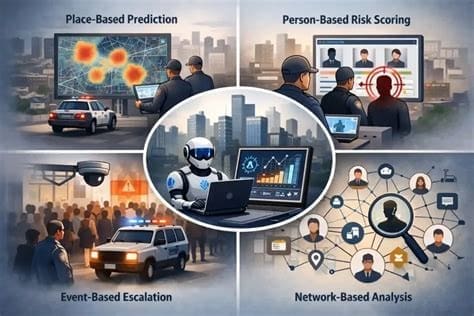
U.S. Government and Private Sector Surveillance Networks
The United States operates a comprehensive surveillance apparatus that has evolved from post-9/11 data collection into AI-driven governance systems.
The American Surveillance System: What’s Really Being Built?
The surveillance apparatus built over the past thirty years was not inevitable. It was constructed through specific decisions: legislative, judicial, executive, and commercial. Decisions that were made can, in principle, be revisited. But that requires recognizing the system for what it is, not for what its architects say it was built to do.
America did not merely accumulate surveillance powers. It built a surveillance economy. Economies do not self-liquidate. They have to be dismantled.
That is the unresolved question this investigation leaves standing: not whether the system exists, but whether the political will to address it will ever outpace the institutional and commercial interests that depend on its continuation.
Based on what three decades of evidence shows, that question does not have a comfortable answer. We call it the control grid. You can call it whatever you choose.