
Understanding American Civics
Large-scale transformation of constitutional culture does not originate in federal legislation or Supreme Court decisions, though both have their role. It originates in counties, in communities, in families, and in institutions built outside the structures of centralized dependency.
Constitutional education at the community level, specifically study of the Federalist Papers, the Bill of Rights, the Declaration of Independence, and state constitutions, produces citizens who understand the architecture of their own authority. This is not ideological programming. It is functional literacy for self-governance.

Your Starting Point for Legal Literacy
When citizens stand in informed knowledge of their lawful authority, government remembers its constitutional position. Constitutional change does not require bullets or slogans. It requires millions of informed citizens operating with moral clarity inside the legal and political structures the founders designed for exactly this purpose.

Start with the Foundation
The constitutional architecture was not an accident of political compromise. It was a deliberate response to historical experience with concentrated power. The founders distrusted kings, parliaments, standing armies, and at times even the general public when susceptible to demagoguery.

Understand the Structure
Read the original texts without relying on secondary commentary to form the initial understanding. The Declaration of Independence, the Constitution, the Bill of Rights, and the Federalist Papers are primary sources that are publicly available and require no intermediary.

Know Your Rights
Hold individual officials personally accountable for specific decisions, not just institutional outcomes. Institutions diffuse accountability. Individuals make decisions. Identify the decision-makers and address them directly through legal and political processes.
Core Civics Topics for Every Citizen
A population without self-discipline cannot sustain liberty because it cannot govern itself. When internal moral constraint fails, external enforcement must expand to fill the vacuum. As civic character declines, institutions grow. As institutions grow, individual freedom contracts. As freedom contracts, dependency increases. The pattern does not reverse itself automatically. It compounds.
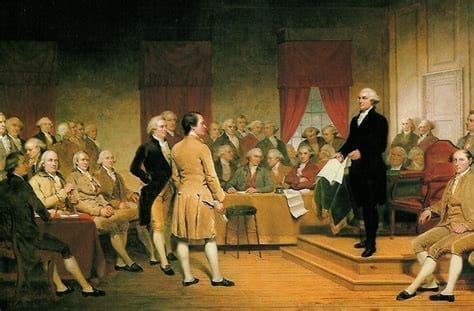
Foundations of American Government and Constitutional Law
The Declaration of Independence, the Constitution, and the Bill of Rights form the bedrock of the American system. These documents define the purpose of government and establish its limits.

Structure of Government
The hierarchy the founders established is not complicated. The individual precedes the Constitution. The Constitution precedes the government. The government answers to the people.

Rights and Responsibilities,
The Constitution does not execute itself. It provides the framework within which free people are responsible for maintaining their own liberty through daily, specific, disciplined acts of civic engagement. Rights that are not exercised atrophy.
Why This Matters
Across the country, citizens are finding themselves in the position of having to explain constitutional language to the very civil servants who swore an oath to uphold it. The phrase “shall not be infringed” is not ambiguous. Neither is “Congress shall make no law.” These are not starting points for negotiation. They are prohibitions.
The question before the country today is not whether enemies of constitutional order exist. The question is whether enough Americans still understand what the Constitution is, what it prohibits, and what it compels citizens to do when power drifts beyond its lawful boundaries.

Civic Participation
Real engagement includes communication with representatives, involvement at the local level, understanding legislative processes, and applying pressure where it counts.

Media, Influence, and Information Control
Media, technology platforms, and institutional messaging all influence public perception, often in ways that are not immediately visible.

The Administrative State
Rules, regulations, and enforcement actions are often created and carried out by unelected bodies operating within complex legal frameworks.
Liberty Requires Law, and Law Requires Moral Foundation
The solution is not additional legislation. The legislation already exists in abundance. What is missing is the character that makes law functional as a boundary rather than a bureaucratic obstacle to be navigated around. When conscience operates within, coercive force need not operate without. Freedom in the constitutional tradition is not permission to do whatever one chooses. It is the liberty to act with self-determined moral agency, free from coercive interference from either criminal actors or overreaching government.