
RIGHTS AND RESPONSIBILITIES
— A Reality Check on the American Experiment —
Rights are some of the most invoked and least understood concepts in the United States.
Everyone claims to defend them. Few can define them.
Politicians package them as slogans. Schools recite them as trivia. But the Founders didn’t frame them as talking points, they saw them as the restraints that bind government, not privileges government dispenses.
And every right carries its counterpart: responsibility.
One without the other becomes tyranny, either of rulers over the ruled or of mobs over minds.
This page exists to remind Americans what our rights actually are, where they came from, and what they require of us.
WHAT A RIGHT ACTUALLY IS
A right is not a government favor.
It is a condition inherent to your existence — something you could exercise even on a desert island, because it flows from your humanity, not your government.
Jefferson’s Declaration said it plainly:
“We are endowed by our Creator with certain unalienable Rights.”
Madison’s Bill of Rights was meant to handcuff federal power, not to grant privileges. Every “Congress shall make no law…” in the First Amendment is a fence around government, not a permission slip for citizens.
If rights come from God or nature, they are beyond repeal.
If they come from politicians, they vanish the moment you irritate them.
HOW RIGHTS FUNCTION IN PRACTICE
In theory, rights are clean.
In reality, they exist only to the degree that courts, lawmakers, and citizens enforce them.
Rights must constantly be:
- Asserted (by individuals)
- Defended (through courts and activism)
- Maintained (through vigilance)
Every generation inherits freedom only if it fights for it. The Founders called that the price of liberty.
NATURAL RIGHTS VS LEGAL PROTECTIONS
Natural Rights
- Exist regardless of any government.
- Recognized, not created, by law.
Core examples acknowledged by the Founders:
- Life
- Liberty
- Property (later reworded as “pursuit of happiness,” but property was the core)
- Expression
- Self-defense
Legal Protections
- The machinery that enforces or restrains government to respect those rights.
- Found in:
- The Constitution
- The Bill of Rights
- State constitutions
- Common law precedent
Constitutional text doesn’t make you free; it outlines how power must behave as if you already are.
HOW THE SYSTEM WAS SUPPOSED TO WORK:
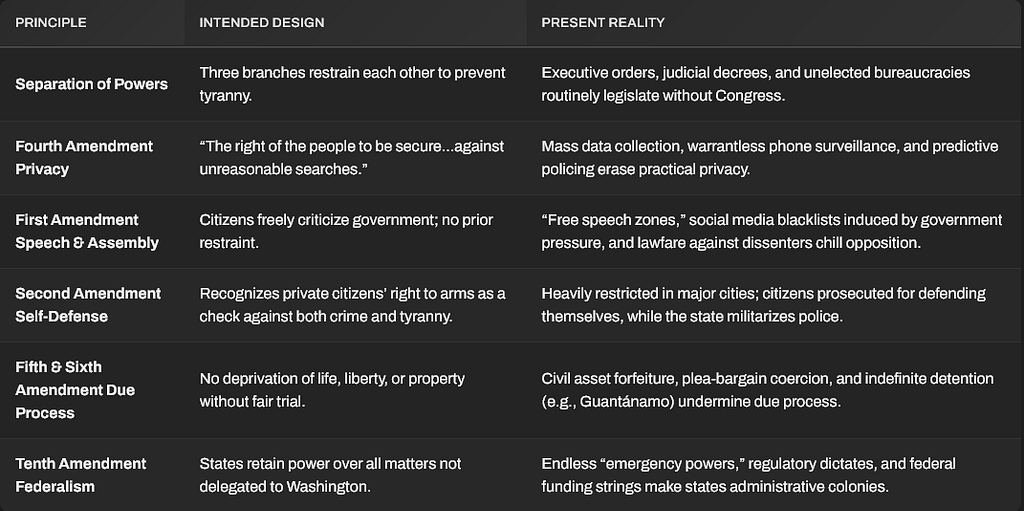
LIMITS AND ABUSES
Every right can have rational limits — but modern governments often disguise control as “balance.”
- Time, Place, and Manner: originally meant narrow, viewpoint-neutral rules. Now used to ban inconvenient gatherings.
- “Public Safety”: once meant imminent threat; now invoked for everything from banning protest to censoring online speech.
- Competing Rights: once meant balancing citizens’ liberties with others’; now weaponized to privilege politically aligned groups.
The Founders accepted restriction only when it prevented direct harm. Today, restriction is justified to prevent offense.
INTERPRETATION: WHERE RIGHTS LIVE OR DIE
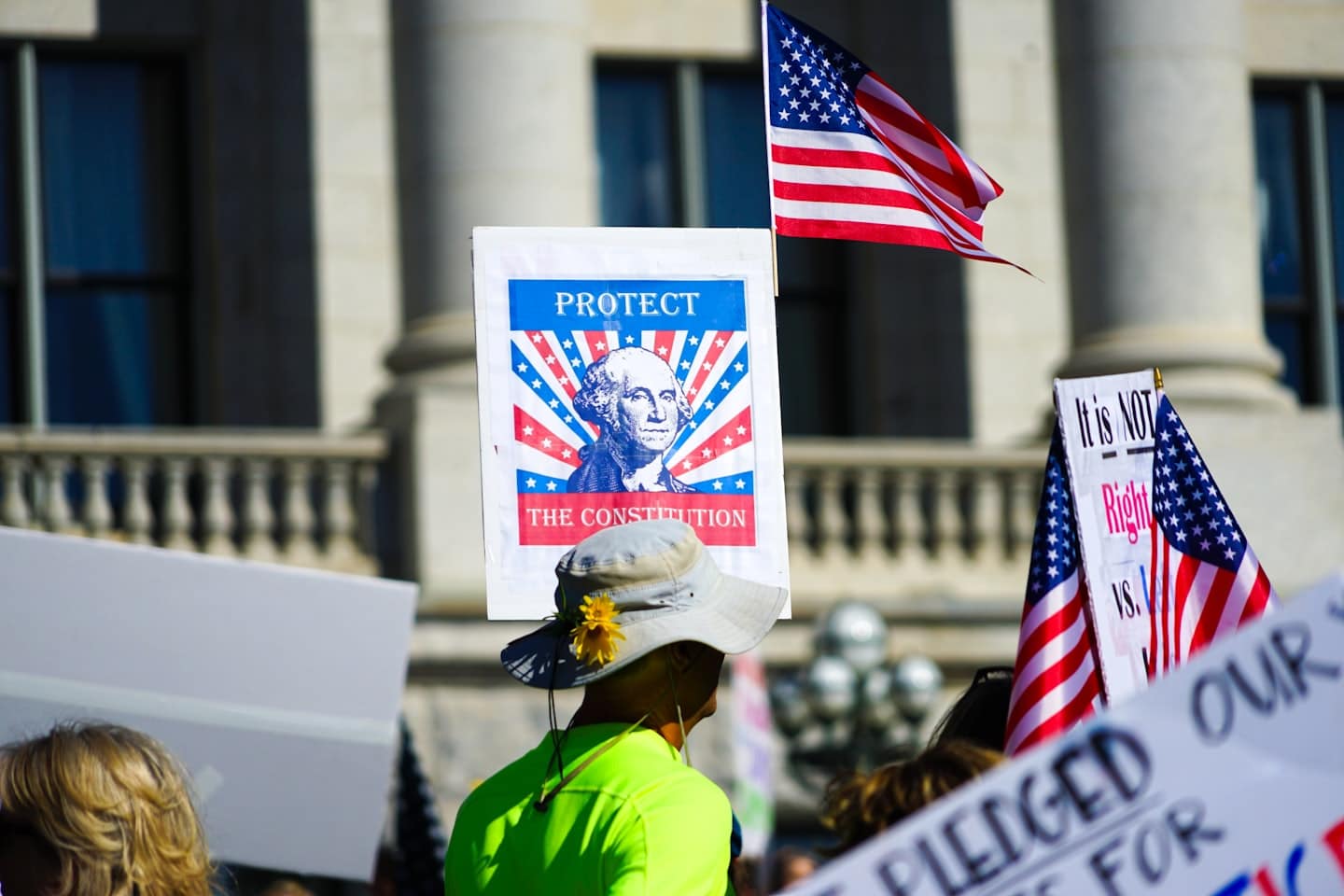
The Constitution doesn’t interpret itself. Courts do and their interpretation often determines whether rights remain real or rhetorical.
Original constitutional model:
- Judges apply law, they don’t create it.
- Meaning fixed at ratification.
Modern practice:
- The “living Constitution” doctrine transforms fixed rights into flexible privileges, redefining limits according to fashion.
- Decisions like Korematsu, Patriot Act precedents, and pandemic emergency rulings show: courts obey power more often than they constrain it.
Interpretation is the battlefield where government converts “shall not” into “unless convenient.”
RESPONSIBILITIES:
THE OTHER HALF OF LIBERTY
Freedom isn’t flight from duty—it’s its acceptance.
Responsibilities are the stabilizing gravity of a free nation.
Civic Responsibility
- Understand your founding documents.
- Vote with knowledge, not emotion.
- Watch officials relentlessly; they fear oversight more than rebellion.
Legal Responsibility
- Exercise your rights lawfully.
- Respect others’ equal rights—not government-imposed “equity.”
Personal Responsibility
- Self-govern before you demand to be governed.
- Live by conscience, not convenience.
- Freedom dies first within the undisciplined man.
WHY RESPONSIBILITY MATTERS
A nation obsessed with rights but ignorant of duties breeds chaos.
Chaos justifies control.
And control is always sold as “safety.”
The Founders anticipated this cycle. Washington warned that moral decay would destroy liberty faster than any foreign army. Jefferson wrote that eternal vigilance, not hierarchy, preserves freedom.
Rights protect the citizen from the state.
Responsibilities protect the republic from its citizens.
Remove either and the Constitution collapses into parchment.
WHY FEW AMERICANS UNDERSTAND ANY OF THIS
Civic education was once designed to produce citizens; now it produces voters.
Children memorize amendments but are never told:
- Where rights originate (natural law, not bureaucratic permission)
- How to defend them (lawful dissent, jury duty, informed resistance)
- What limits are legitimate (only those grounded in harm, not ideology)
An ignorant populace isn’t self-governing—it’s self-managed.
RESTORING A WORKING UNDERSTANDING
To think like a free American, ask five questions about every law or policy:
- Where does this right originate? Natural law or political fashion?
- How is it protected? Constitutional clause, statute, or sheer custom?
- How is it limited? Safety, convenience, or censorship?
- Who enforces it? The citizen or the bureaucracy?
- What responsibility mirrors it?
- Free speech → truth and civility.
- Right to bear arms → discipline and competence.
- Property → stewardship and work ethic.
- Due process → fairness toward others.
Ask these, and the fog clears fast.
- Rights are simple in theory and sacred in origin
- They exist beyond government
- Require law to protect them,
- Depend on honest interpretation,
- Survive only when citizens uphold responsibility.
When Jefferson wrote that the tree of liberty must be refreshed, he wasn’t glorifying violence; he meant renewal through courage, awareness, and action.
A republic survives not by trust, but by accountability.
And accountability begins with understanding the difference between being governed and being free.