

The American system of government is
built on structure, not personality.
It does not depend on who is in office.
It depends on how power is distributed, limited, and checked.
At least, that is how it was designed.
Understanding government starts with understanding structure—who holds authority, where that authority comes from, and how it is supposed to be controlled.
Without that, everything else looks random.
With it, patterns start to appear.
The Core Design
The structure of American government is built on two primary ideas:
- Separation of Powers
- Federalism
These are not abstract concepts. They are the operating framework.
They exist for one reason:
To prevent the concentration of power.
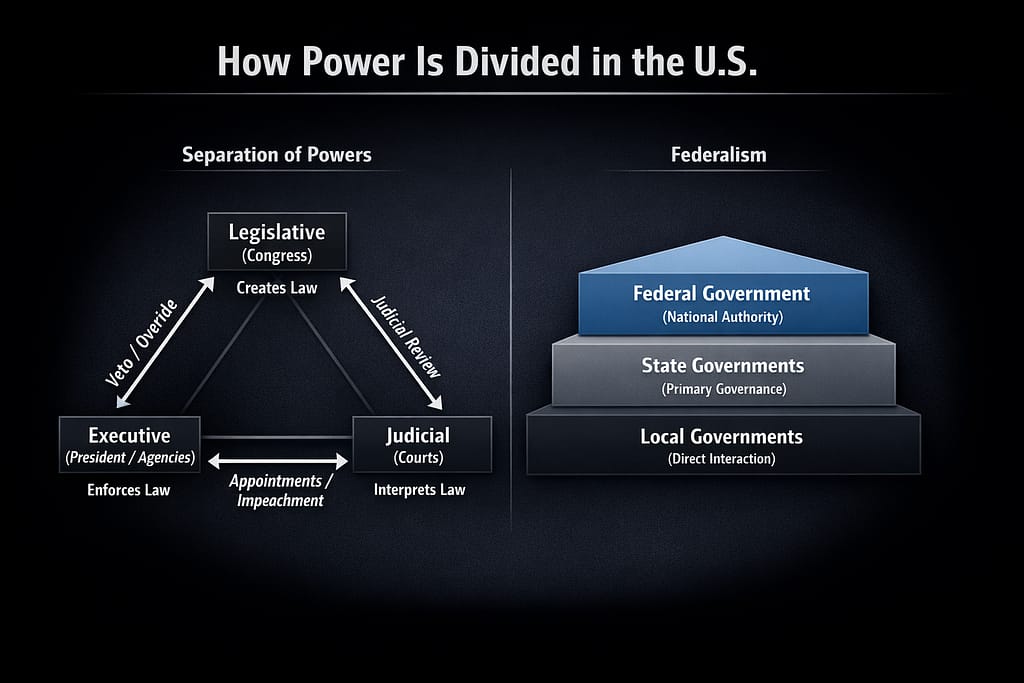
Separation of Powers-Divided Authority
The federal government is divided into three branches.
Each branch has a defined role. Each branch has limits. Each branch is supposed to act as a check on the others.
Congress is responsible for creating laws.
It is made up of two chambers:
- House of Representatives
- Senate
Its powers include:
- Writing and passing legislation
- Controlling federal spending
- Declaring war
- Overseeing executive agencies
Congress is closest to the people by design. It is supposed to reflect public will.
But it also holds one of the most important powers in the system:
The power to create law.
The Executive Branch enforces the law.
At the top is the President.
Below that is a large network of departments and agencies.
Its responsibilities include:
- Enforcing laws passed by Congress
- Conducting foreign policy
- Commanding the military
- Managing federal agencies
This is where scale enters the system.
Because enforcement requires infrastructure.
And infrastructure grows.
The Judicial Branch interprets the law.
At the top is the Supreme Court, supported by lower federal courts.
Its role includes:
- Interpreting the Constitution
- Reviewing laws and executive actions
- Resolving disputes between parties and governments
The courts do not create law in the same way Congress does.
But interpretation carries power.
Because the meaning of law determines how it is applied.
CHECKS AND BALANCES — BUILT-IN FRICTION —
These branches are not independent silos.
They are designed to interfere with each other.
That interference is intentional.
Examples:
- The President can veto laws
- Congress can override vetoes
- Courts can strike down laws as unconstitutional
- Congress can impeach executive and judicial officials
- The Senate confirms appointments
This creates friction.
Friction slows things down.
That is the point.
A system that moves too easily can be captured too easily.
FEDERALISM. DIVIDING POWER BY LEVEL
Power is not only divided between branches.
It is also divided between levels of government.
Federal Government
Handles national-level issues:
- National defense
- Foreign policy
- Interstate commerce
- Currency
Its powers are supposed to be limited to what is enumerated in the Constitution.
State Governments
States retain broad authority.
They handle:
- Criminal law
- Education
- Property law
- Most day-to-day governance
States are not subdivisions of the federal government.
They are separate governments within the system.
Local Governments
Cities and counties operate at the most immediate level.
They handle:
- Law enforcement
- Zoning
- Local ordinances
- Community services
This is where citizens interact with government most directly.
WHY THIS STRUCTURE EXISTS
This system was not designed for efficiency.
It was designed for restraint.
The founders understood a basic principle:
Power tends to expand.
So instead of trusting individuals, they built a system that forces power to compete with itself.
- Branch against branch
- State against federal
- Process against speed
It is not clean.
It is not fast.
But it is harder to control from a single point.
WHERE THE SYSTEM GETS COMPLICATED
On paper, the structure is clear.
In practice, it becomes layered.
Over time:
- Congress passes broad laws
- Authority is delegated to executive agencies
- Agencies create regulations
- Courts interpret those regulations
This creates an additional layer inside the system:
The administrative state.
These agencies operate within the Executive Branch but often create rules that function like law.
That shifts how power is exercised.
Not outside the system.
But deeper inside it.
THE ROLE OF THE ADMINISTRATIVE STATE
Most Americans are familiar with Congress and the President.
Fewer understand agencies.
But agencies play a major role in modern governance.
They:
- Write regulations
- Enforce compliance
- Interpret policy
Examples include departments
responsible for:
- environmental regulation
- financial oversight
- communications
- transportation
These bodies are not elected.
But they operate with delegated authority.
Understanding this layer is critical if you want to understand how government actually functions today.
WHY MOST PEOPLE MISS THIS
Civics education usually stops at:
- three branches
- basic functions
- simplified roles
What gets left out is:
- how power is delegated
- how agencies operate
- how interpretation expands authority
The result is a surface-level understanding.
People recognize the structure.
But they don’t understand how it behaves.
BUILDING A WORKING MODEL
To understand government, you don’t need to memorize everything.
You need to track a few key questions:
- Who created the rule?
- Who enforces it?
- Who interprets it?
- Where did the authority originate?
Follow those questions, and the system becomes visible.
Ignore them, and it stays abstract.
The structure of government is not hidden.
But it is layered.
Three branches. Multiple levels. Expanding systems.
It was designed to limit power.
The question is not whether the structure exists.
The question is how it is used.
And whether it still functions as intended.