Alright, let’s strip this down to first principles and explain it the way it actually works—not the way civics textbooks soften it.

Think of the United States government as a massive employment structure. The People are the employers. The government—every branch, agency, and official—is the workforce. That’s not a metaphor for effect. That’s the design.

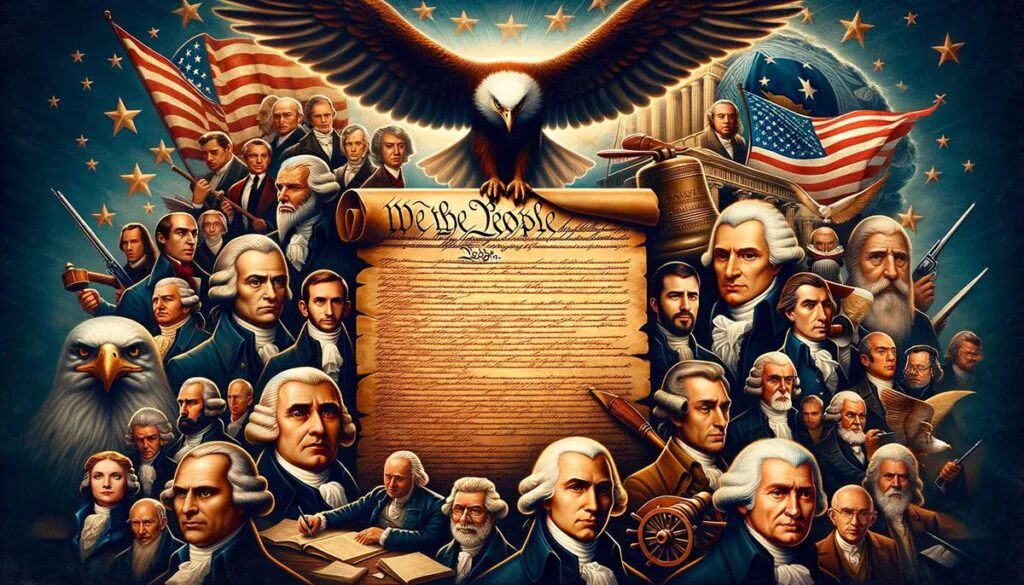
Start with the source of authority. Power does not originate in Washington, agencies, courts, or elected offices. It originates with the People collectively. The Constitution didn’t create rights; it acknowledged pre-existing rights and then created a limited job description for government. In other words, the People hired a government to perform specific tasks and forbade it from doing anything outside that scope.

The Founders understood this employment relationship explicitly. They had just fired their previous government—King George and Parliament—for breach of contract. The Declaration of Independence reads like a termination letter: here’s what we hired you to do, here’s how you violated the terms, here’s your notice. The Constitution that followed wasn’t an upgrade to unlimited authority—it was a more restrictive contract with clearer boundaries and better firing mechanisms.

In employer terms, the Constitution is the employment contract. It lays out what the employees are allowed to do, how they’re selected, how long they serve, and how they can be fired or restrained when they overstep. Anything not explicitly assigned to the federal government is automatically retained by the People or delegated to the states. That’s not a suggestion—it’s a hard boundary.

Read the Tenth Amendment again: “The powers not delegated to the United States by the Constitution, nor prohibited by it to the States, are reserved to the States respectively, or to the people.” Translation: if it’s not in the job description, you don’t get to do it. Period.

Now look at the branches as departments inside a company.

    The legislative branch is the rule-writing department. Congress’s job is narrow: write laws that stay within constitutional limits and reflect the will of the People. They don’t get to invent authority, outsource their job, or rule by vague “intent.” If they stop legislating and hand that job to agencies, they’re abandoning their post.

But that’s exactly what happened. Congress discovered they could avoid accountability by writing vague laws and letting agencies fill in the details. Pass a bill called “Clean Air Act” with fuzzy language, then let the EPA write the actual rules. When those rules destroy industries or cost jobs, Congress points at the agency and shrugs. It’s delegation without responsibility—like a manager assigning work but refusing to review the output.

The legislative branch has another problem: they’ve turned permanent. The Founders expected rotation. Serve a term, go home, live under the laws you wrote. Instead, we have career politicians who treat office like property and legislation like their personal legacy project. When employees stop leaving, they stop remembering who they work for.

The executive branch is operations and enforcement. The President and executive agencies are not lawmakers. They are managers and workers whose only role is to carry out the laws exactly as written. No freelancing. No policy creation. No “we know better.” When agencies start issuing rules that function like laws, they’re acting like employees rewriting their own job description.

    Here’s where the system broke completely: the administrative state. Agencies now write rules, enforce those rules, and judge violations of those rules—all while being funded by the employer they’re regulating. That’s not government. That’s a protection racket.

Take any federal agency and trace its expansion. The Department of Education didn’t exist until 1979. Now it has nearly 4,000 employees and a $80 billion budget, despite education being explicitly reserved to states and local communities. The EPA started with environmental protection and now regulates puddles in backyards as “navigable waters.” These agencies don’t shrink—they metastasize.

The executive branch also suffers from permanent employees who outlast elected officials. Career bureaucrats embed in agencies for decades, building informal power structures that persist regardless of elections. When new administrations try to implement voter mandates, these embedded employees resist, delay, and sabotage. They act like tenure-track professors with government authority—accountable to no one, removable by no mechanism.

The judicial branch is quality control and contract enforcement. Courts exist to resolve disputes and ensure the government stays inside the contract. They are not moral philosophers, super-legislators, or social engineers. When courts invent doctrines that excuse government overreach, they’re siding with management against the employer—which, in any real company, would be grounds for termination.

But courts have become legislatures in robes. They find “penumbras” and “emanations” in constitutional text to justify results they prefer. They defer to agency “expertise” instead of checking agency authority against the actual law. They create doctrines like “qualified immunity” that shield government employees from consequences when they violate citizens’ rights.

    The Supreme Court’s Commerce Clause jurisprudence illustrates the problem perfectly. The Constitution gives Congress power to regulate commerce “among the several states.” For 150 years, that meant actual commerce crossing state lines. Then courts decided it meant anything that might theoretically affect interstate commerce. Now it covers wheat grown for personal consumption, marijuana used for medical purposes, and virtually any economic activity. The employer’s contract was rewritten without the employer’s consent.

Elections are performance reviews. They’re not celebrations, rituals, or loyalty tests. They are the mechanism by which the employer decides who stays employed. Voting isn’t about gratitude or symbolism—it’s about accountability. Poor performance is supposed to result in replacement.

But elections have been systematically insulated from consequences. Gerrymandering creates safe seats where performance doesn’t matter. Campaign finance turns candidates into products sold to the highest bidder rather than employees accountable to voters. Media narratives replace actual evaluation of results.

Most importantly, the permanent government—agencies, bureaucrats, contractors—never appears on ballots. Citizens can fire the President and every member of Congress, but the Department of Homeland Security keeps operating, the Federal Reserve keeps manipulating interest rates, and the intelligence agencies keep surveilling Americans. The deep state isn’t a conspiracy theory—it’s an employment structure designed to be unfireable.

Taxes are payroll. The government does not generate its own money. Every dollar it spends is taken from the People. That means waste, fraud, and bloat aren’t abstract problems—they’re employees burning the employer’s money and then demanding raises.

Consider the numbers: federal spending consumes roughly 25% of GDP. State and local governments add another 15%. That means 40% of everything produced in America goes to government employees and their priorities. If any private company demanded 40% of its customers’ income while delivering declining service quality, those customers would fire the company immediately.

Government accounting makes the waste worse by obscuring it. Private companies track profit and loss quarterly. Government uses baseline budgeting—if you spent 100 billion last year and only increase spending to 100 billion last year and only increase spending to 105 billion this year, that’s counted as a $5 billion “cut” even though spending increased. Debt doesn’t count as real money. Future obligations get pushed off-books.

    Public office is not prestige. It’s a position of trust with fiduciary responsibility. Officials are obligated to act in the best interest of the People they serve, not foreign governments, corporations, agencies, political parties, or ideologies. When they prioritize anything else, they’re violating that trust.

But the incentive structure rewards the opposite. Officials get wealthy through book deals, speaking fees, and consulting contracts that depend on their government connections. They retire to lobbying firms that pay them to influence their former colleagues. They make decisions based on what builds their personal brand rather than what serves constituents.

Foreign influence operates the same way. Officials make policy decisions that benefit other countries because those countries offer lucrative post-government opportunities. Israel doesn’t need to bribe American politicians directly—they just need to ensure that pro-Israel positions lead to profitable consulting contracts after officials leave office.

Here’s the part that often gets quietly erased: the People never surrendered sovereignty. They delegated limited authority conditionally. Delegation is reversible. Authority can be revoked. Compliance is not consent, and silence is not approval.

The government wants citizens to believe they’re subjects who should be grateful for whatever rights government chooses to permit. That’s backwards. Citizens are sovereigns who hired a government to perform specific services. When that government stops performing or starts exceeding its authority, the contract can be modified or terminated.

    The mechanisms exist: elections, impeachment, constitutional amendments, civil disobedience, and ultimately revolution. The Founders included the Second Amendment precisely because they understood that all other accountability mechanisms might fail. An armed citizenry is the final check against tyrannical employees.

When government acts as if it is the employer—issuing commands without justification, punishing dissent, expanding its own power, shielding itself from consequences—that’s not “how government works.” That’s a breach of contract.

The pandemic response demonstrated this perfectly. Governors and mayors issued emergency orders that lasted years, shutting down businesses, restricting movement, and mandating medical procedures without legislative approval. Courts deferred to “public health expertise.” The same officials who demanded compliance partied maskless while enforcing mask mandates on everyone else.

If this were a whiteboard, the center visual would be simple: a large group labeled “The People” holding the contract. Below them, arrows pointing downward to three smaller boxes labeled Legislative, Executive, Judicial—each with a checklist of duties, not powers. Off to the side, a big bold note: “Authority flows UP, not down.” And another, underlined twice: “Employees do not outrank the employer.”

That’s the system as designed. Everything else—the confusion, the bureaucracy, the permanent agencies, the unaccountable rules—is what happens when employees forget who signs the checks.

The solution isn’t reform. It’s enforcement. The employer needs to start acting like an employer again.

Leave a Reply