
I need you to understand something most civics classes deliberately obscure.
The Constitution doesn’t grant you rights. It never did.
It restrains government from touching the rights you already possess. The difference isn’t semantic—it’s the entire structural logic of the American system. And somewhere between 1787 and now, that logic got inverted.
You were taught the inversion. So was I. We learned that the Bill of Rights “gives us” freedom of speech, freedom of religion, the right to bear arms. We learned to be grateful to the document for bestowing these privileges.
That’s backwards.
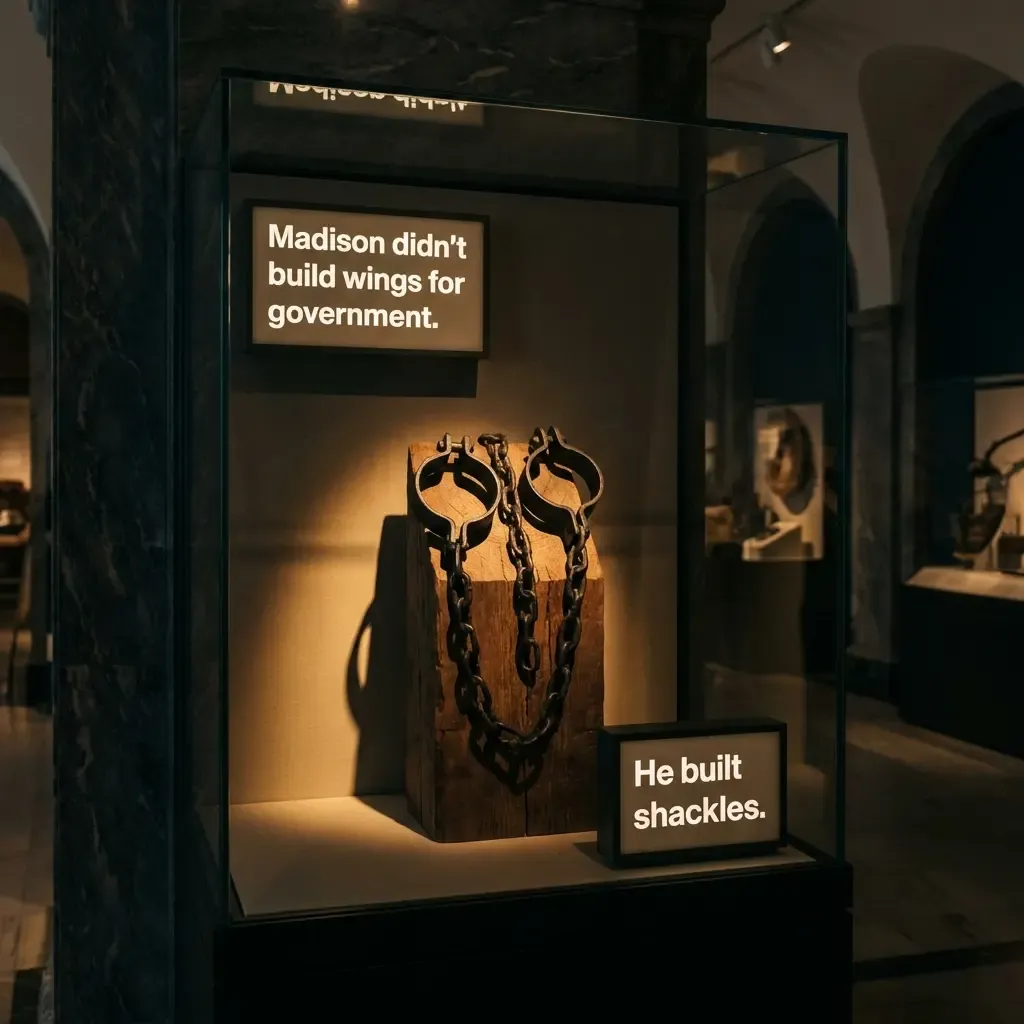
The Founders didn’t design wings for government. They designed shackles.
Madison Built a Cage, Not a Benefactor
James Madison understood what most modern Americans have forgotten: government is the threat, not the protector.
When he architected the constitutional framework, he wasn’t thinking about how to empower a benevolent state. He was thinking about how to prevent an inevitable predator from devouring liberty.
In Federalist 51, Madison laid it out: “Ambition must be made to counteract ambition.”
That’s not a management philosophy. It’s a containment strategy.
The Constitution’s structure assumes government will seek to expand. The checks and balances weren’t designed to make government function smoothly—they were designed to make government devour itself before it could devour you.
Every enumerated power in Article I, Section 8 is a fence. If the power isn’t listed, the federal government doesn’t have it. The specificity wasn’t bureaucratic housekeeping—it was the shackle.
The default position was liberty. Government had to justify each specific power it claimed. Everything not explicitly granted was reserved to the states or the people.
That’s the opposite of how power operates now.
The Bill of Rights Is a List of Prohibitions
Read the First Amendment again.
“Congress shall make no law…”
Not “Congress grants you the right to free speech.” Not “The government bestows upon citizens the privilege of assembly.”
Congress shall make no law.
The language is a restraining order. It’s a command directed at government, not a gift delivered to citizens.
Were the Constitution the source of your right to speak, the First Amendment would read differently. It would say “Citizens are hereby granted freedom of speech.” But it doesn’t. Because the right preexisted the document.
The Bill of Rights doesn’t create rights—it forbids government interference with rights you already possess.
This is what’s called negative rights. A negative right is one that cannot be infringed by outside forces. It exists independent of government recognition. The Constitution simply prohibits government from touching it.
Madison initially opposed adding a Bill of Rights to the Constitution. Not because he opposed the rights themselves—but because he understood the inversion risk.
He worried that listing specific rights might create the impression that unlisted rights didn’t exist or that government had authority over anything not explicitly forbidden.
James Wilson argued the same point: enumerating rights might imply that all those not listed were surrendered. And because you can’t enumerate every right a free person possesses, a Bill of Rights could be weaponized to justify government power over unlisted liberties.
They were right to worry.
The Ninth Amendment Was an Insurance Policy Against the Inversion
Madison knew the risk. So he built a fail-safe.
The Ninth Amendment exists specifically to prevent the inversion you’ve been taught.
“The enumeration in the Constitution, of certain rights, shall not be construed to deny or disparage others retained by the people.”
Translation: Just because we listed these rights doesn’t mean these are the only ones you have.
Madison explained it directly in his speech introducing the Bill of Rights: “It has been objected also against a bill of rights, that, by enumerating particular exceptions to the grant of power, it would disparage those rights which were not placed in that enumeration.”
He saw the psychological trap. He tried to prevent it.
The Ninth Amendment is a firewall. It says: your rights are not a product of this document. Your rights are inherent. This document merely restricts government from violating them.
But firewalls only work if people remember they exist.
The Preamble to the Bill of Rights—Deliberately Forgotten
Most people have never read the preamble to the Bill of Rights.
It’s not taught. It’s not quoted. It’s inconvenient.
Here’s what it says:
“THE Conventions of a number of the States having at the time of their adopting the Constitution, expressed a desire, in order to prevent misconstruction or abuse of its powers, that further declaratory and restrictive clauses should be added.”
Declaratory and restrictive clauses.
Not grants. Not permissions. Restrictions on government power.
The preamble makes the purpose explicit. The Bill of Rights exists to prevent government from misconstruing or abusing its powers.
You don’t have constitutional rights. You have rights. The Constitution has restrictions.
How the Inversion Became Institutional
Somewhere in the last century, the operating logic flipped.
Government became the default. Liberty became the exception.
You now ask permission for what was once assumed. You apply for permits to exercise rights that preexist the state. You navigate regulatory frameworks that exist entirely outside constitutional boundaries.
This didn’t happen by accident.
The administrative state is a constitutional inversion at scale. Over the past 100 years, governance migrated from a limited, enumerated structure to a centralized apparatus that operates outside the framework Madison designed.
The architects of the administrative state understood this. They weren’t trying to work within the constitutional system—they were trying to replace it.
The numbers make it visible.
Nearly 450 federal agencies. 2.7 million bureaucrats. In 2013 alone, 3,659 final rules were issued. The Code of Federal Regulations spans 175,496 pages across 235 volumes.
None of that appears in Article I, Section 8.
Madison defined tyranny in Federalist 47: “The accumulation of all powers, legislative, executive, and judiciary, in the same hands, may justly be pronounced the very definition of tyranny.”
The administrative state accumulates all three powers in unelected agencies.
Justice Clarence Thomas recognized the structural abandonment: “We have overseen and sanctioned the growth of an administrative system that concentrates the power to make laws and the power to enforce them in the hands of a vast and unaccountable administrative apparatus that finds no comfortable home in our constitutional structure.”
The system you navigate daily is not the system the Constitution describes.
What Happens When You Understand the Inversion
Once you see it, you can’t unsee it.
Every permit you apply for becomes a question: why am I asking permission to do what I’m already entitled to do?
Every regulation becomes a test: does this restriction appear in the enumerated powers, or is it administrative overreach operating outside constitutional bounds?
Every time someone says “the Constitution gives us freedom of speech,” you hear the inversion. And you recognize how the inversion serves power.
If government grants rights, government can revoke them. If rights are gifts from the state, the state decides when you’ve been ungrateful enough to lose them.
But if rights preexist government—if they’re inherent to your existence as a free person—then government has no legitimate claim to them.
The Constitution doesn’t empower you. It chains the state.
Understanding that distinction changes how you read every law. How you evaluate every policy. How you respond when someone tells you to be grateful for freedoms you were born possessing.
Madison didn’t build a system to grant you liberty.
He built a system to prevent anyone from taking it.
The shackles are still there. Most people just forgot they were designed to restrain government, not citizens.
Leave a Reply