
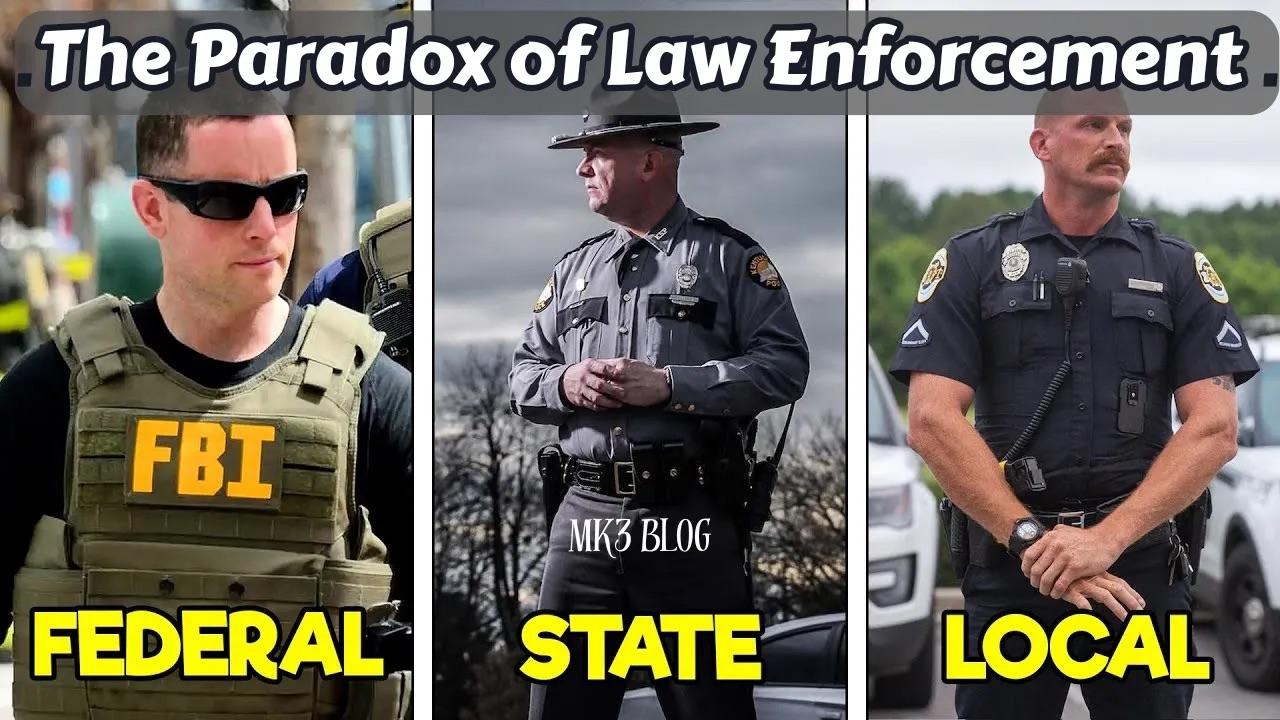
Modern law enforcement operates within a legal and philosophical paradox: it routinely violates the very laws it is sworn to uphold, often with explicit legal protection. This contradiction is not an anomaly it is institutionalized. From entrapment tactics and undercover operations to national security exemptions and qualified immunity, the state has built a framework that allows it to break its own rules while maintaining the appearance of order. The justification is utilitarian: the ends justify the means. But when those ends are determined by self-interested agencies rather than independent justice, the system incentivizes the manufacture of crime, not its prevention.
This pattern is not new. It has evolved over decades, shaped by political shifts, judicial deference, and bureaucratic incentives. What began as covert counterintelligence operations in the 1970s transformed into domestic drug stings in the 1980s, then morphed into post-9/11 counterterrorism theater, and now extends into ideological policing of protest movements. At each stage, the state has refined its ability to create, prosecute, and publicize crimes it itself engineered—while shielding its agents from accountability.
I. The Legal Architecture of State Lawbreaking
The foundation of this paradox lies in legal doctrines that grant the state exceptional powers. Carl Schmitt’s famous dictum; “Sovereign is he who decides on the exception” captures the core principle: the state reserves the right to suspend its own laws when it deems necessary. In practice, this “exception” has been codified through mechanisms that function as legal valves, allowing the system to bend or break its own rules without collapsing.
Key among these are:
- Undercover operations, where agents infiltrate groups and encourage illegal acts.
- Entrapment tactics, in which informants supply the means, motive, and opportunity for crime.
- National security exemptions, which permit warrantless surveillance, rendition, and even torture.
- Qualified immunity, which shields police officers from civil liability unless they violate “clearly established” rights—a standard so narrow it renders most misconduct unpunishable.
- Prosecutorial discretion and plea bargains, which allow prosecutors to manufacture outcomes by threatening extreme sentences unless defendants plead guilty.
These tools collectively enable the state to preserve its image of impartiality while operating outside the bounds of the law it enforces on citizens. The result is a two-tiered legal system: one for the governed, another for the governors.
II. Entrapment and the Manufacture of Crime
Entrapment is no longer a fringe tactic; it is a central pillar of modern federal policing. The U.S. Supreme Court has long held that entrapment occurs only if the defendant was not “predisposed” to commit the crime. But this subjective test has been weaponized. Agencies now use long-term psychological manipulation, financial incentives, and fabricated scenarios to create predisposition where none existed.
Landmark cases illustrate the problem:
- In United States v. Russell (1973) and Hampton v. United States (1976), federal agents supplied the essential ingredients for narcotics production. The Court upheld the convictions, effectively ruling that as long as the government’s goal was law enforcement, its illegal acts were immune.
- In United States v. Tobias (1981), a DEA agent mailed all the chemicals needed to make PCP to an amateur chemist, coached him by phone, and still secured a 15-year sentence. The court reasoned that the defendant “could have refused”—ignoring the reality of coercion.
- The ATF’s “stash house” stings in the 2000s lured small-time offenders into robbing nonexistent drug cartels. By 2014, judges like Otis Wright condemned these operations as “crimes cut from whole cloth,” yet many convictions stood due to the predisposition loophole.
Post-9/11, this model expanded into counterterrorism. The FBI’s playbook became systematic:
- Target selection: Focus on ideologically useful demographics—young, isolated men, often Muslim or disaffected veterans.
- Inducement: Use paid informants (frequently criminals themselves) to befriend targets, offer money, and escalate talk of violence.
- Resource provision: Supply fake explosives, weapons, or transportation.
- Predisposition construction: Scour social media for offhand comments or memes to retroactively “prove” intent.
- Public relations: Announce the “foiled plot” to justify budgets and reinforce the narrative of omnipresent threat.
Studies by Jesse Norris (2015–2020) found entrapment indicators in over 70% of post-9/11 terrorism prosecutions. Defendants like the Liberty City Seven (2006) and the Newburgh Four (2009) had no real capacity to carry out attacks until the FBI provided every element of the crime. In 2023, a federal judge resentenced the Newburgh Four, calling the operation “an FBI theatrical production.”
Yet the entrapment defense fails nearly 100% of the time. Why? Prosecutors control discovery, hiding informant files. Defendants face draconian sentencing enhancements, forcing guilty pleas. Judges defer to “national security.” And media coverage frames every sting as a heroic intervention, not a manufactured spectacle.
III. Judicial and Doctrinal Enablers
The courts have not merely tolerated this system. They have fortified it through doctrine.
- Qualified Immunity: Created by the Supreme Court in Pierson v. Ray (1967) and expanded since, it requires plaintiffs to show that an officer violated a right that was “clearly established” in prior case law. Because courts rarely rule on constitutional violations (often dismissing cases on procedural grounds), the cycle repeats: first violations go unpunished, making future ones “legal.”
- Whren v. United States (1996): The Court ruled that as long as an officer has anyobjective reason for a traffic stop—even a minor violation—the stop is constitutional, regardless of racial profiling or ulterior motives. This legalized pretextual policing.
- Heien v. North Carolina (2014): The Court held that police can make “reasonable mistakes of law” during stops. A 2024 study by Steven Goldstein found that 67% of such errors were upheld as “reasonable.” Ignorance of the law is now an excuse—if you wear a badge.
- Color of Law (18 U.S.C. §242): While this statute criminalizes officials who deprive citizens of rights, it requires proof of “willfulness”—a near-impossible standard. Convictions are vanishingly rare.
- Outrageous Government Conduct Doctrine: Though recognized in theory (e.g., Eve Zelinger, Hastings Const. L.Q., 2018), the Supreme Court has never applied it to overturn a conviction. The state remains free to “shock the conscience” without consequence.
These doctrines dismantle the symmetry of the law. Citizens must know and obey every statute; officers need only claim good faith or reasonable belief.
IV. Historical Evolution: From COINTELPRO to Counterterrorism
The roots of today’s system lie in the Cold War. Although COINTELPRO was officially shut down in 1971 after Church Committee revelations, its methods were reabsorbed in the 1980s under Reagan. Attorney General William French Smith loosened the 1976 Levi Guidelines, allowing domestic intelligence gathering without evidence of criminal activity. This rollback became the legal DNA of modern stings.
Operation PATCON (1991–1993) exemplifies the shift. FBI agents infiltrated right-wing militia groups, armed them, encouraged violence, and then arrested them for plots the Bureau itself created. Internal memos show operatives pushing for criminal activity to justify budget lines. This template resurfaced post-9/11 in stings targeting Muslim communities.
Internationally, similar patterns emerged. In the UK, MI5 and Special Branch deployed agent provocateurs in anti-nuclear and environmental movements, committing kidnappings and using false evidence. These practices culminated in the Spycops scandal(exposed 2011–2025), where over 140 officers used fake identities, some based on dead children’s birth certificates to infiltrate 1,000+ political groups. Many engaged in sexual relationships, even fathering children, to maintain cover. The Met Police later admitted the practice was “abusive, manipulative and wrong”; but no officers were prosecuted.
In 2025, the MI5 False-Evidence Scandalrevealed the agency lied to three courts about an abusive informant. Despite a High Court ruling condemning MI5’s “procedurally deficient” internal inquiries, no one faced charges, protected by the “national security” shield.
V. Covert Illegality and the National Security Exception
The “national security exception” has become the ultimate legal escape hatch. After 9/11, the Office of Legal Counsel issued secret memos (the Bybee/Yoo memos) redefining torture as “enhanced interrogation.” CIA agents acting under presidential authorization were granted de facto immunity. The Senate Intelligence Committee’s 2014 report documented systematic criminality, but no prosecutions followed. Torturers were shielded by “good-faith reliance” on legal advice.
Domestically, the Snowden revelationsexposed how the Foreign Intelligence Surveillance Court secretly redefined “relevance” under FISA §215 to mean “everything,” enabling mass surveillance in violation of the Fourth Amendment. Lawbreaking was legalized through secret reinterpretation, rule by secrecy, not law.
Meanwhile, Project Veritas v. Schmidt (2025, 9th Circuit) highlighted a stark double standard: Oregon law criminalizes private undercover recordings but grants police exceptions. The court ruled that only state-authorized covert acts serve the “public good,” formalizing a monopoly on truth-gathering.
VI. Institutional Psychology: Oversight as Theater
Oversight mechanisms are designed to absorb scandal, not prevent misconduct. Inquiries drag on for years, deliver redacted reports, issue apologies, and recommend reforms that are ignored. Agencies gain legitimacy from public contrition while operational culture remains unchanged. The population is pacified by ritual exposure not structural change.
Consider Ontario’s Special Investigations Unit (SIU): over 15 years, it investigated 159 cases of police misconduct. One-third of charges were withdrawn by prosecutors; most trials ended in acquittals. This is not accountability—it is ritual absolution. “Civilian oversight” functions as symbolic legitimacy maintenance, simulating justice to sustain public confidence while shielding insiders.
The same dynamic plays out in the U.S. Police departments release bodycam footage only when it exonerates officers. Internal affairs investigations are opaque. Disciplinary records remain secret. The system judges itself—and always finds itself innocent.
VII. The Feedback Loop: From Terror to Protest
By the 2010s, the counterterrorism playbook was redeployed against domestic activists. The FBI’s Joint Terrorism Task Forces (JTTFs) and local fusion centers began labeling environmentalists, anti-pipeline protesters, and Black Lives Matter organizers as “extremists.” Informants funded marches, provoked talk of sabotage, and delivered edited logs to prosecutors.
In the UK, officers like Mark Kennedy (“Stone”) infiltrated climate groups for years, even testifying falsely in court. When exposed, the state apologized but the underlying policy persisted. The Justice & Security Act 2013introduced Closed Material Procedures, allowing false testimony to be shielded by “national security” claims.
This expansion reflects a broader shift: ideological policing. The state no longer waits for crimes—it polices thought, association, and dissent. “Radicalization” becomes a pre-crime category, justifying surveillance and disruption before any illegal act occurs.
VIII. The Economics of Fabricated Crime
From an institutional perspective, manufactured crimes are budget subsidies. Every “counterterrorism success” justifies grant renewals. Conviction quotas incentivize agents to create solvable plots rather than pursue dangerous real actors. Entrapment has evolved into a bureaucratic self-licking ice cream cone—a machine that exists to feed itself.
Communities bear the cost. As Diala Shamas documents, Muslim-Americans have been subjected to coercive informant recruitment: FBI agents used No-Fly List threats and immigration leverage to force cooperation. Refusal could mean job loss or permanent travel bans. This informal surveillance draft operates without statutory oversight, blurring civil intelligence with criminal law.
IX. Breaking the Cycle: Pathways to Legitimate Enforcement
Ending this paradox requires structural transparency and distributed accountability. Proven counter-forces include:
- Independent journalism and whistleblowing – Figures like Daniel De Simone (MI5 exposé), Edward Snowden, and Chelsea Manning have forced hidden crimes into the open.
- Jury nullification – When jurors see the full record, they often reject state narratives, as seen in acquittals of activists entrapped by informants.
- Radical transparency laws – Mandating public access to police disciplinary records, abolishing secret courts, and allowing civilian admissibility of covert recordings.
Concrete reforms should include:
- Abolish qualified immunity to restore individual accountability.
- Replace the “predisposition” entrapment test with an objective standard: Was the government’s conduct itself criminally coercive?
- Mandate disclosure of all informant compensation and tasking orders.
- Create independent prosecution unitsinsulated from local political influence.
- Legalize citizen recording to document undercover inducement.
- Criminalize entrapment as conspiracy, ensuring equal culpability between agent and target.
X. The Philosophical Endgame
The phrase “break the law to enforce the law” echoes through history from the Soviet Cheka to the Patriot Act. Every empire that justified exceptional policing in the name of safety eventually discovered that safety was an illusion. The enforcers became untouchable.
What’s needed is not better training or bodycams, but a moral correction in the psychology of power. Law must not be a weapon to defend institutions, but a restraint on all authority—especially institutional authority.
As Justice Brandeis warned:
“The greatest dangers to liberty lurk in insidious encroachment by men of zeal, well-meaning but without understanding.”
That is the danger of breaking the law to enforce it: it is always done with zeal, never understanding. The MK3 voice does not shout. It documents, analyzes, and states the truth. Whether it’s comfortable or not.
Leave a Reply