
The 14th Amendment to the United States Constitution, ratified in 1868, is often hailed as a cornerstone of civil rights and equal protection. However, a closer examination of its history, ratification process, and subsequent interpretation reveals a more complex and contentious narrative. This amendment, ostensibly designed to free human beings from chattel slavery, has been used to justify expansive federal power, leading some to question its legitimacy and constitutionality.
The Text and Initial Intent
The 14th Amendment consists of several key sections, including the Citizenship Clause, the Due Process Clause, and the Equal Protection Clause. The Citizenship Clause states that all persons born or naturalized in the United States are citizens of the United States and of the state wherein they reside. The Due Process Clause prohibits states from depriving any person of life, liberty, or property without due process of law. The Equal Protection Clause mandates that no state shall deny to any person within its jurisdiction the equal protection of the laws.
Initially, the primary intent of the 14th Amendment was to address the legal status of freed slaves and ensure their rights were protected. It was a response to the post-Civil War era, where former Confederate states were enacting Black Codes and other discriminatory laws to subjugate newly freed African Americans. The amendment aimed to provide a constitutional basis for the protection of these individuals’ rights and to integrate them into the American polity.
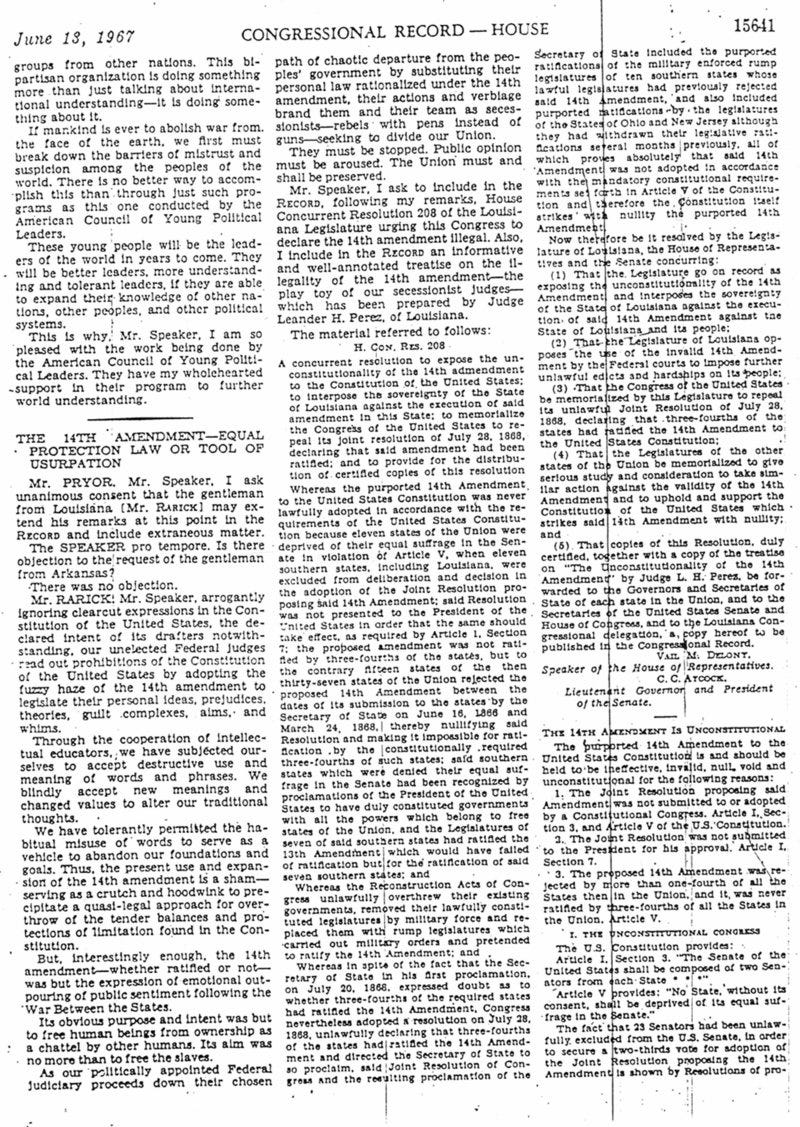
Pictured is page 15641 of the Congressional Record from the U.S. House of Representatives, June 13, 1967. Rep. John Rarick (D-Louisiana) submitted this and an additional six pages of material to support his claim that the 14th Amendment was (and is) illegal. As we can see, 40 years later, Congress has not yet gotten around to recognizing the 14th’s illegality.
The Ratification Controversy
The ratification process of the 14th Amendment has been a subject of significant debate. Critics argue that the amendment was not properly ratified according to the procedures outlined in Article V of the Constitution, which requires a two-thirds vote in both houses of Congress and ratification by three-fourths of the states.
One of the most contentious issues is the exclusion of Southern states from the ratification process. During the Reconstruction era, many Southern states had their governments overthrown and replaced with military-enforced “rump legislatures.” These rump legislatures were then coerced into ratifying the 14th Amendment, leading to questions about the legitimacy of their actions. Some argue that the exclusion of these states from the Senate violated the principle of equal suffrage, as stated in Article V of the Constitution.
Additionally, there were procedural irregularities. For example, the proposed amendment was not submitted to the President for his approval, as required by Article I, Section 7. Furthermore, several states, including Ohio and New Jersey, initially ratified the amendment but later withdrew their ratification. Despite these withdrawals, the Secretary of State declared the amendment ratified, adding to the controversy.
Judicial Interpretation and Expansion
The 14th Amendment’s interpretation by the judiciary has been a source of significant expansion of federal power. The Supreme Court, through a series of landmark cases, has used the 14th Amendment to incorporate the Bill of Rights, making the protections of the First, Fourth, Fifth, and Sixth Amendments, among others, applicable to the states. This process, known as the Incorporation Doctrine, has been a powerful tool for expanding individual rights but has also been criticized for exceeding the original intent of the amendment.
Critics argue that the 14th Amendment has been used to centralize power and erode the principles of federalism. The amendment’s broad language has allowed the courts to interpret it in ways that expand federal authority, often at the expense of state sovereignty. This has led to the federal government’s involvement in areas traditionally reserved for the states, such as education, healthcare, and criminal justice.
The 16th Amendment Parallels
The 16th Amendment, which allows for the collection of an income tax, shares some parallels with the 14th Amendment. Both amendments were highly controversial and hotly contested, and both were “ratified” under circumstances that have been questioned. The 16th Amendment, like the 14th, has been used to expand federal power, particularly in the realm of taxation and regulation.
During the debates leading up to the 16th Amendment, the term “income” was understood to refer to corporate profits and investment gains, not wages and salaries. However, the definition of “income” was expanded to include wages and salaries, allowing the federal government to tax what was previously considered personal property. This expansion of the definition of “income” has been a source of ongoing debate and criticism.
The Argument for Unconstitutionality
Some scholars and legal experts argue that the 14th Amendment is unconstitutional due to the procedural and substantive issues surrounding its ratification. One of the most detailed arguments against the 14th Amendment’s validity was presented by Judge Lander H. Perez in a treatise titled “The Unconstitutionality of the 14th Amendment.”
Perez argues that the 14th Amendment was not properly adopted because:
- Unconstitutional Congress: The Joint Resolution proposing the 14th Amendment was not submitted to or adopted by a Constitutional Congress. The exclusion of Southern states from the Senate violated the principle of equal suffrage.
- Lack of Presidential Approval: The proposed amendment was not submitted to the President for his approval, as required by Article I, Section 7.
- Ratification Issues: The proposed 14th Amendment was rejected by more than one-fourth of all the states then in the Union, and it was never ratified by three-fourths of all the states in the Union.
These arguments have been echoed by various state legislatures, including Louisiana, which passed House Concurrent Resolution 208 in 1967. This resolution urged Congress to declare the 14th Amendment illegal and to interpose the sovereignty of the State of Louisiana against the execution of the amendment. The resolution cited the procedural irregularities and the coercive nature of the ratification process as grounds for declaring the amendment unconstitutional.
The Impact on Federal Power
The 14th Amendment has been a pivotal tool for the expansion of federal power. It has been used to justify a wide range of federal interventions, from regulating commerce to enforcing civil rights. While these interventions have often been necessary and beneficial, they have also raised concerns about the balance of power between the federal and state governments.
The amendment’s broad language has allowed the courts to interpret it in ways that expand federal authority. For example, the Due Process Clause has been used to incorporate the Bill of Rights, making the protections of the First, Fourth, Fifth, and Sixth Amendments, among others, applicable to the states. This incorporation has been a powerful tool for expanding individual rights but has also been criticized for exceeding the original intent of the amendment.
The Equal Protection Clause has been used to challenge discriminatory laws and practices, leading to significant advancements in civil rights. However, it has also been used to justify federal intervention in areas traditionally reserved for the states, such as education and healthcare. This has led to a centralization of power and a reduction in state sovereignty, raising concerns about the erosion of federalism.
Conclusion
The 14th Amendment, while intended to protect the rights of newly freed slaves, has become a tool for the expansion of federal power. Its ratification process and subsequent interpretation have been subjects of significant debate and controversy. Critics argue that the amendment was not properly ratified and that its broad language has been used to centralize power and erode the principles of federalism.
As we consider the 14th Amendment’s place in our constitutional framework, it is essential to examine its history, ratification, and interpretation. The amendment’s impact on federal power and the balance between the federal and state governments is a critical issue that continues to shape our understanding of the Constitution and the role of government in our lives.