By Malcolm Lee Kitchen III | MK3 Law Group
(c) 2026 – All rights reserved.
The founding generation understood something modern Americans have forgotten: permanent military forces pose an existential threat to free government. Their solution was deliberate and radical; replace standing armies with an armed population organized as militia.
This wasn’t theoretical policy debate. These men had lived under military occupation. They watched British soldiers patrol Boston streets, enforce tax collection, and ultimately fire into crowds of civilians. When colonial resistance intensified in 1774, Britain’s response revealed the true relationship between government power and citizen disarmament. British forces moved systematically to confiscate colonial weapons, understanding that control over arms meant control over resistance.
Patrick Henry captured the stakes plainly: “The militia, sir, is our ultimate safety. We can have no security without it.” Henry and his contemporaries had seen how quickly professional soldiers became tools of oppression rather than protection.
Why Standing Armies Destroy Liberty
Noah Webster stated the mechanism directly: “Before a standing army can rule, the people must be disarmed.” The founders observed this pattern repeatedly throughout history. Professional military forces, separated from civilian life and dependent on government pay, inevitably become instruments of state power rather than national defense.
George Mason expressed the widespread revulsion toward permanent forces: “I abominate and detest the idea of a government, where there is a standing army.” This wasn’t pacifist sentiment. Mason understood that standing armies create a separate class with interests distinct from the general population.
St. George Tucker explained the consequences of this separation: “Wherever standing armies are kept up, and the right of the people to keep and bear arms is, under any color or pretext whatsoever, prohibited, liberty, if not already annihilated, is on the brink of destruction.” Tucker identified the fatal combination: professional forces plus disarmed civilians equals tyranny.
The founders’ opposition wasn’t absolute. They recognized military necessity during actual warfare. But they understood that peacetime standing armies serve different masters than wartime forces defending against invasion.
The Militia Alternative
George Mason defined the crucial difference: the militia consists of “the whole people, except a few public officers.” This wasn’t metaphor. The militia was the armed population itself, not a separate institution. Citizens remained civilians while serving as the primary defense force.
Henry Knox, the first Secretary of War, made this distinction operational. In his 1790 plan for national defense, Knox wrote: “An energetic national militia is to be regarded as the Capital security of a free republic; and not a standing army, forming a distinct class in the community.”
Knox continued: “Whatever may be the efficacy of a standing army in war, it cannot in peace be considered as friendly to the rights of human nature.” This reflected mainstream thinking among the founding generation. Professional soldiers might serve useful functions during active warfare, but peacetime military forces posed inherent dangers to civilian government.
Constitutional Framework
The Philadelphia Convention debates reveal how deeply these concerns shaped the Constitution itself. George Mason proposed adding explicit language about standing army dangers to the militia clause: “And that the liberties of the people may be better secured against the danger of standing armies in times of peace.”
While this specific language didn’t survive the drafting process, it demonstrates the framers’ thinking. They weren’t designing a military system. They were constructing safeguards against military power.
James Madison argued that effective militia organization would eliminate justification for permanent forces: “As the greatest danger to liberty is from large standing armies, it is best to prevent them by an effectual provision for a good militia.”
Alexander Hamilton, often portrayed as favoring strong federal power, acknowledged the same principle in Federalist 29: “To render an army unnecessary, will be a more certain method of preventing its existence than a thousand prohibitions upon paper.”
The Jefferson-Madison Exchange
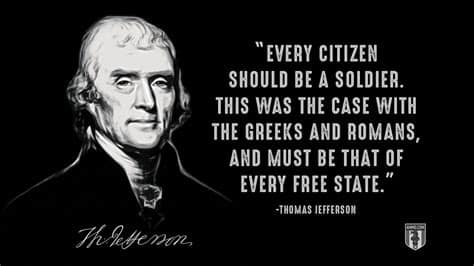
Thomas Jefferson’s response to reading the proposed Constitution illuminates the strategic thinking behind militia preference. Jefferson urged Madison to provide for “the substitution of militia for a standing army.” This wasn’t suggestion for improvement; it was identification of a fundamental requirement for free government.
During Virginia’s ratifying convention, Madison explained the practical implementation: “If insurrections should arise, or invasions should take place, the people ought to unquestioningly be employed, to suppress and repel them, rather than a standing army.”
Madison’s logic was structural: “The most effectual way to guard against a standing army is to render it unnecessary.” How? “Give the general government full power to call forth the militia, and exert the whole natural strength of the Union, when necessary.”
This approach solved multiple problems simultaneously. It provided genuine defense capability while maintaining civilian control over military force. It prevented the creation of a separate military class with interests apart from the general population.
Operational Reality
Tench Coxe described the practical advantages: “The militia, who are in fact the effective part of the people at large, will render many troops quite unnecessary.” An armed population capable of organized defense eliminates most justifications for permanent military establishments.
James Monroe provided the clearest summary during Virginia’s ratifying debates: “All countries are more or less exposed to danger, either from insurrection or invasion and the greater the authority of Congress over this respectable body of men, in whose hands every thing would be safe, the less necessity there would be, to have recourse to the bane of all societies, the destroyer of the rights of men, a standing army.”
Monroe identified the key insight: when defense depends on the armed population itself, that population cannot be oppressed by military force. The defenders and the defended are identical.
Modern Implications
The founders’ framework addressed a permanent tension in free societies. Every government needs defense capability, but defense forces can become oppression tools. Professional armies serve government interests rather than popular interests. Militia systems serve popular interests because militia members are the population itself.
This distinction matters more than weapon technology or military doctrine. The institutional relationship between defense forces and civilian population determines whether those forces protect or threaten liberty.
The founding generation’s choice was deliberate: accept certain military inefficiencies to prevent military tyranny. They prioritized citizen control over professional optimization. They understood that perfect defense systems often become perfect oppression systems.
Modern America has reversed this calculus entirely, building massive professional forces while restricting citizen armament. The founders would recognize this as the precise combination they designed the Constitution to prevent.
Their solution remains available: well-armed citizens organized for defense, minimizing dependence on professional military power. The question is whether contemporary Americans retain sufficient understanding of liberty’s requirements to implement it.
© 2026 – MK3 Law Group
For republication or citation, please credit this article with link attribution to MarginOfTheLaw.com.
What do you think?