
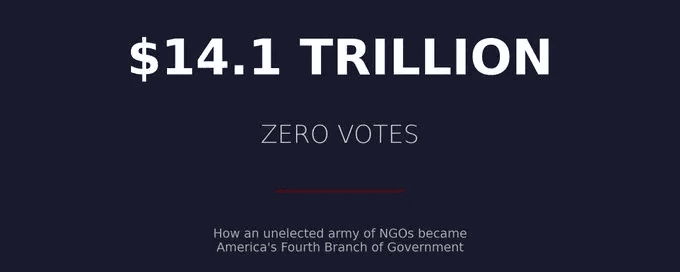
By Malcolm Lee Kitchen III | Margin Of The Law
There is a structure of power operating inside the United States that controls more wealth than most nations on Earth. It writes legislation that lawmakers pass without reading. It funds the offices that count your votes. It trains the journalists who shape what you believe. It sues federal agencies into adopting rules that Congress never authorized.
It is not the White House. It is not Congress. It is not the Supreme Court.
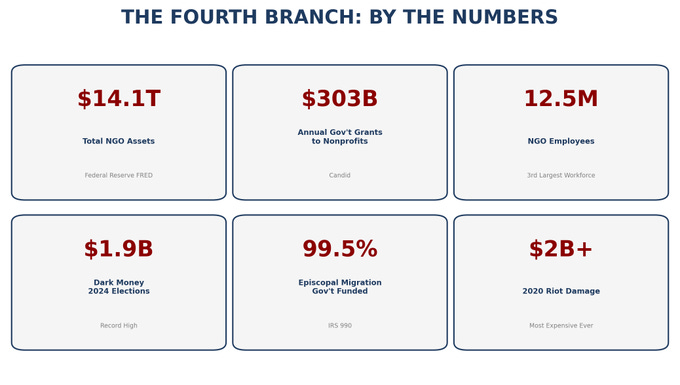
It is the American nonprofit sector. And according to the Federal Reserve’s own data, it now controls $14.1 trillion in total assets.
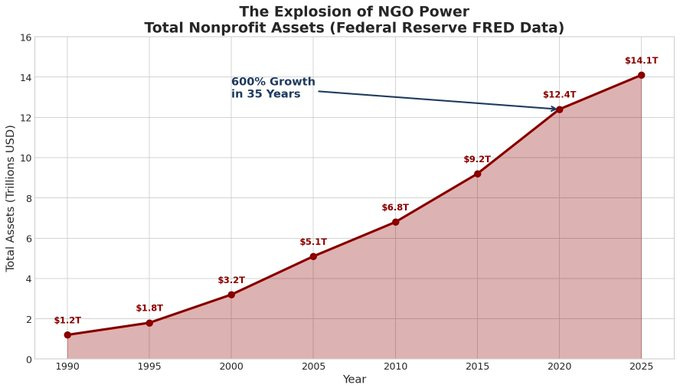
That number requires context to fully register. The 14.1trillion nonprofit infrastructure exceed the combined GDP of Japan, Germany, and India. It surpasses the entire federal budget. It has grown from under 2 trillion in the 1990s to a financial force that now rivals nation-states in scale and exceeds most of them in political influence.
Not one dollar of it answers to a single American voter.
This is not a fringe claim. The data is documented in Federal Reserve reports, IRS filings, foundation annual reports, and Congressional testimony. The architecture is visible to anyone willing to look. What it represents, when examined in full, is the systematic circumvention of the constitutional order that the Founders designed to protect self-government.
Understanding how this happened, and how far it has progressed, begins with the numbers.
THE ASSET BREAKDOWN
The Federal Reserve’s financial accounts of the United States break down nonprofit assets in ways that demand attention.
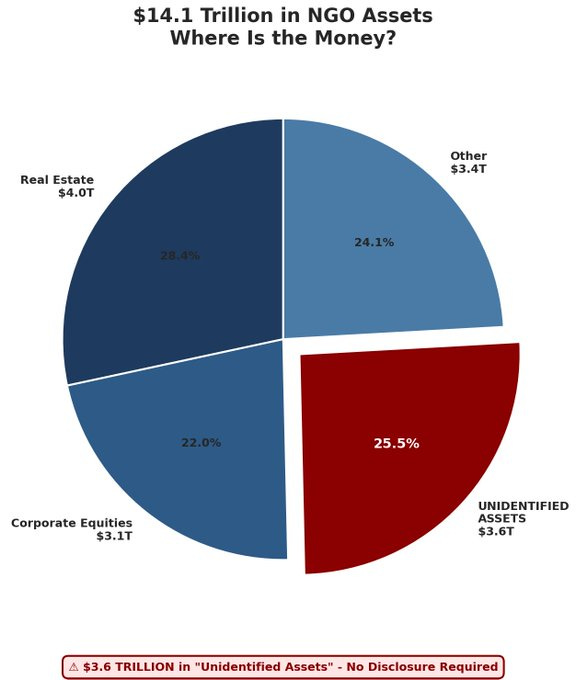
Of the 14.1 trillion total, $4.0 trillion sits in real estate holdings. Another $3.1 trillion is held in corporate equities. Those figures are large, but traceable.
The number that should concern you most is $3.6 trillion listed under assets that the Federal Reserve does not categorize. Three-point-six trillion dollars described as something the federal government’s central banking system does not find necessary to specify. In any framework of public accountability, that absence of categorization is itself significant information.
The growth trajectory matters as much as the current figure. In the early 1990s, total nonprofit assets in the United States sat below 2trillion.That means the sector has grown by more than $12trillion in roughly three decades, outpacing federal budget growth, outpacing GDP growth, and outpacing the growth of virtually every other measurable financial sector in the country.
That growth did not happen randomly. It was built, deliberately and strategically, by organizations that understood what the founders of the American constitutional system understood: concentrated wealth is concentrated power.
THE ARCHITECTURE OF INVISIBILITY
The United States Constitution established three branches of government and built accountability mechanisms into each one. The executive branch faces voters every four years. Members of the House face them every two. Senators face them every six. Federal judges, appointed for life, survive Senate confirmation before they ever issue a ruling.
The accountability structures are imperfect. They have always been contested and sometimes abused. But they exist. They are constitutional features, not accidents.
The $14.1 trillion nonprofit infrastructure has no equivalent accountability structure. There are no elections. There are no confirmation hearings. There are no term limits, no recall mechanisms, no impeachment proceedings. Directors serve indefinitely, answer to self-selected boards, and exercise enormous political power without any formal mechanism by which ordinary citizens can check, challenge, or remove them.
James Madison wrote in Federalist No. 51 that if men were angels, no government would be necessary. The entire architecture of the Constitution rests on the assumption that power must be checked, balanced, and answerable to the governed. That logic applies to formal government institutions. The question the Founders did not anticipate was whether an unelected financial infrastructure could accumulate sufficient power to effectively govern without being government.
That question is no longer theoretical.
The nonprofit sector now writes model legislation distributed to state legislatures through organizations like the American Legislative Exchange Council on the right and the State Innovation Exchange on the left. It funds the legal organizations that sue federal agencies and state governments into compliance with policies that no legislature approved. It trains and funds the journalists whose coverage shapes public understanding of every major policy debate. It provides the staffing pipeline for federal agencies through fellowship programs and personnel placement operations.
When power operates through these channels simultaneously, it does not need formal authority to govern. It simply governs.
THE ARABELLA NETWORK
If you want to understand how the progressive left constructed its version of this infrastructure, start with Arabella Advisors.
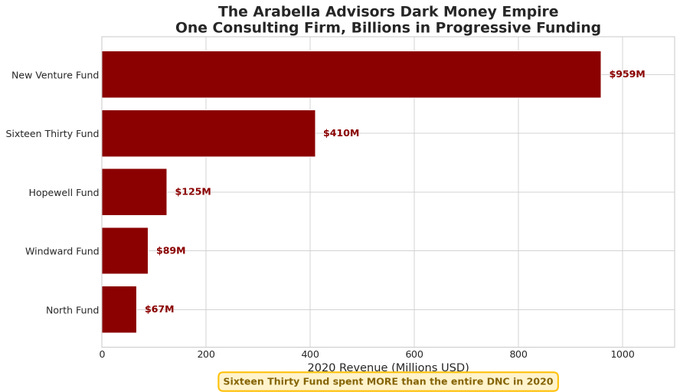
Arabella Advisors is a for-profit consulting firm based in Washington, D.C. that manages a network of nonprofits designed to function as a dark money distribution system for progressive political causes. Most Americans have never heard of it. That is not an accident.
The network’s flagship organization, the Sixteen Thirty Fund, spent $410 million in 2020 alone. That figure exceeded the total spending of the Democratic National Committee for the same period. The New Venture Fund, another Arabella− managed organization, reported $959 million in revenue. The network also includes the Hopewell Fund, the Windward Fund, and the North Fund.
The operational model is built around fiscal sponsorship. Organizations can form under Arabella’s umbrella, spend tens of millions of dollars on political causes, and then dissolve without ever filing their own tax returns. The money flows through the parent organization. The paper trail is minimal. The political impact is real and immediate.
The New York Times reported that after a decade during which progressive organizations attacked undisclosed political spending by conservative groups, the left embraced dark money with, in the paper’s words, “fresh zeal.” In the 2020 election cycle, left-leaning dark money groups outspent their right-leaning counterparts by nearly two to one, channeling more than $1.5 billion in undisclosed cash into American politics.
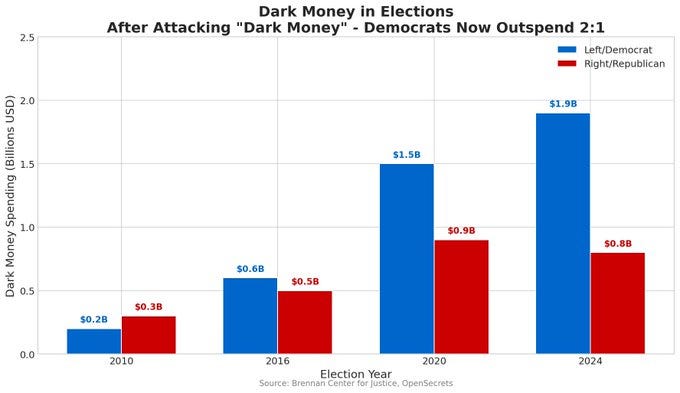
By 2024, total dark money in elections reached a documented $1.9 billion. The Brennan Center for Justice, itself a nonprofit that shapes the public narrative around money in politics, documented this explosion while simultaneously advocating for disclosure rules that its own analysis showed would primarily constrain opponents rather than the foundation-funded left.
The strategy is coherent: build the infrastructure, capture the institutions that referee the debate, write the rules that govern the debate, win the debate. It is not hypocrisy. It is a systematic approach to political power that operates largely outside the constitutional framework designed to make power accountable.
THE BORDER INDUSTRY
No sector of the nonprofit economy illustrates the government-NGO merger more completely than the organizations operating at the southern border.
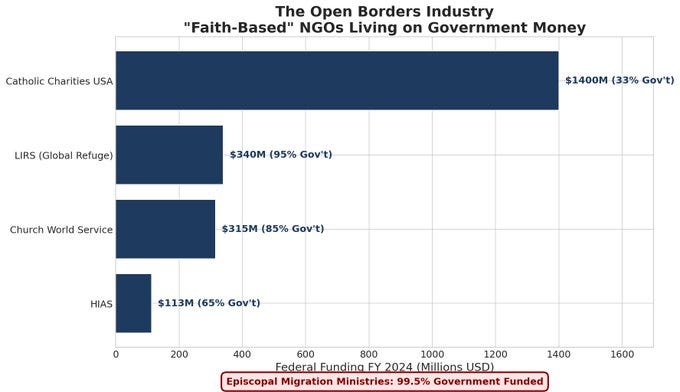
Catholic Charities, Lutheran Immigration and Refugee Service (recently rebranded as Global Refuge), the Hebrew Immigrant Aid Society (HIAS), and Church World Service present themselves as faith-based charitable organizations. Their branding invokes religious mission and humanitarian obligation. Their actual funding structure tells a different story.
In fiscal year 2024, Lutheran Immigration and Refugee Service received over $340 million from the federal government. Their own tax filings show that 95percent of their total revenue came from government sources. Church World Service received over $315 million from the Departments of State, Health and Human Services, and Homeland Security, with government grants constituting 85 percent of their operating budget. HIAS received $113 million in federal funds, representing 65 percent of their total revenue.
These organizations are not charities in any functional sense. They are government contractors. The religious branding is real in terms of the organizations’ origins and stated values, but the operating model is that of a federally funded service provider.
The structural problem extends beyond the funding arrangement. These same organizations use their non-government funds to lobby for immigration policies that will increase the flow of migrants into the United States. More migrants means more federal resettlement contracts. More contracts means more revenue. The incentive structure creates a policy feedback loop funded almost entirely by American taxpayers.
You are paying these organizations to resettle migrants. You are simultaneously paying them to lobby for policies that will ensure they resettle more migrants. You are funding both sides of a policy debate in which, as a voter, you have no formal voice.
When Texas, Arizona, and other states attempted to enforce border security, these organizations funded the lawsuits to block enforcement. When states passed legislation addressing illegal immigration, these organizations deployed legal teams to challenge implementation. The Heritage Foundation described the arrangement as a “corrupt money-changing circle” in which taxpayers fund “migration weaponization used against America’s interests.”
The description is accurate. The mechanism is documented. The funding is public record.
THE 2020 CIVIL UNREST: FUNDING AND ACCOUNTABILITY
The summer of 2020 produced the most expensive civil disorder in American insurance history. Following the death of George Floyd, protests erupted in 140 cities. Many were peaceful. The riots, looting, and arson that accompanied them caused between $1 billion and $2 billion in insured losses according to Property Claim Services, which has tracked insurance claims related to civil disorder since 1950.
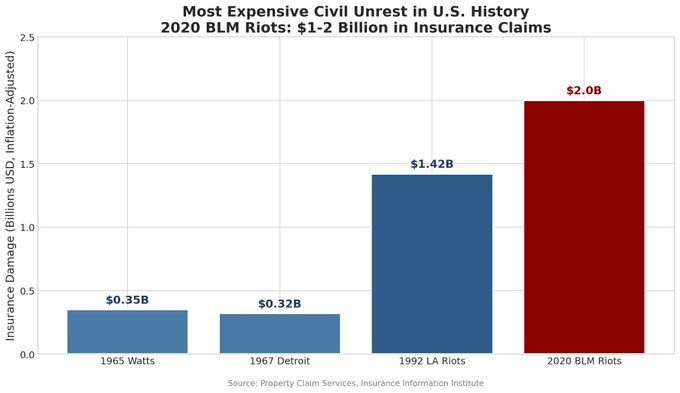
That figure surpassed the previous record set by the 1992 Los Angeles riots following the Rodney King verdict, which cost insurers $775 million in 1992 dollars, or approximately $1.4 billion adjusted for inflation. The 2020 unrest also became the first civil disorder event in American history to cause significant damage across more than one state simultaneously, ultimately affecting more than 20 states.
Dozens of people were killed. Thousands of businesses were looted, torched, or vandalized. A significant proportion of the destroyed businesses were minority-owned operations in communities that had spent decades building economic stability.
Black Lives Matter Global Network Foundation raised approximately 90 million in 2020. The organization′s financial management of those funds became a significant story in itself. Co−founder Patrisse Cullors purchased a $1.4 million home in a predominantly White Los Angeles neighborhood. The organization acquired a $6 million property in Southern California described in organizational communications as intended for influencer housing.
When donors and local BLM chapters demanded financial transparency, the national organization went silent. State attorneys general in California, Washington, and elsewhere opened investigations for failure to file required nonprofit disclosures. The California attorney general’s office found the organization delinquent in its filing obligations. The accountability mechanisms that exist for nonprofits proved largely inadequate to the scale of the problem.
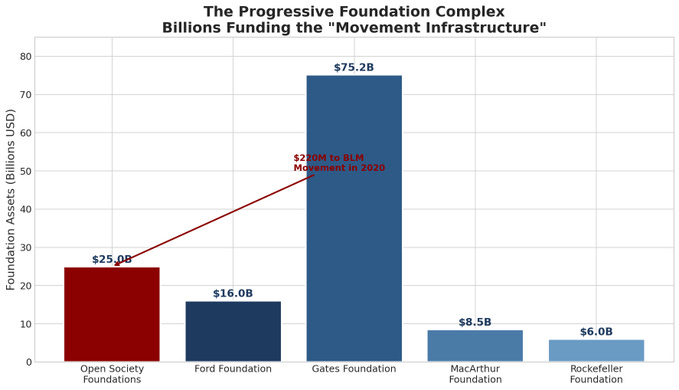
The foundation money that flowed into the 2020 movement dwarfed what the Black Lives Matter organization itself raised. The Ford Foundation, which holds 16 billion in assets, announced it would lead a six−year effort to raise $100 million for the Movement for Black Lives. George Soros’s Open Society Foundations announced $220 million in new funding for aligned organizations in July 2020, as cities were still recovering from the preceding weeks of unrest.
The Open Society announcement was explicit about its objectives. The foundation described its goal as helping the movement “build the solid infrastructure that will enable it to flourish.” The word infrastructure appeared repeatedly in the communications of major foundations funding movement organizations during this period.
That language is precise. Charitable foundations funding social movements are not primarily concerned with immediate relief or direct services. They are investing in permanent political architecture. The distinction matters because it clarifies what kind of organizations these actually are and what kind of power they actually seek.
THE CLIMATE FUNDING OPERATION
Congressional testimony in 2025 detailed the mechanics of how the NGO-government staffing pipeline operates to direct federal funding toward ideologically aligned organizations.
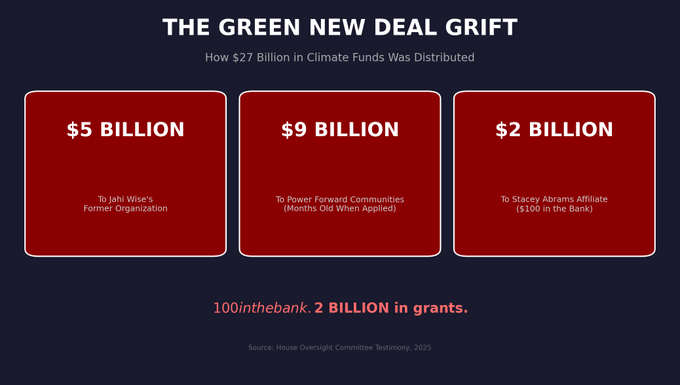
The Inflation Reduction Act directed hundreds of billions of dollars toward climate and clean energy initiatives. The Environmental Protection Agency received tens of billions in grant-making authority. A staffer named Jahi Wise, who came to the EPA directly from an environmental nonprofit called The Coalition for Green Capital, was placed in charge of directing $27 billion in green energy grants.
For context, $27 billion exceeds the combined annual budgets of the Departments of Treasury, Interior, and Commerce. Wise was not a Senate-confirmed official. He faced no confirmation hearing. He received no formal Congressional oversight of his grant-making authority. He held the position because of prior nonprofit credentials and administration connections.
Under his tenure, $5 billion in federal grants went to his former organization, The Coalition for Green Capital. Power Forward Communities, an organization that had existed for only a few months when it submitted its application, received nearly $9 billion to distribute at its own discretion.
One of the grant recipients was an organization affiliated with Stacey Abrams, the Georgia political figure who ran for governor in 2018 and 2022. According to Congressional testimony, this organization held approximately $100 bucks in its bank account when it received $2 billion in federal grants.
One hundred dollars in organizational assets. Two billion dollars in federal grants.
This is not government malfunction. This is the NGO-government pipeline operating as designed. Personnel move from nonprofits into federal agencies. Grant-making authority is concentrated in unconfirmed positions. Grants flow toward organizations connected to the same political and professional networks. The money converts into organizational capacity that will persist regardless of which administration follows.
The constitutional framework requires that significant federal expenditures be subject to Congressional appropriation and oversight. The climate grant structure was designed to move money quickly, through intermediaries, with minimal oversight, before a potential change in administration could interrupt the flow. That design reflects an understanding of how to use nonprofit infrastructure to lock in policy outcomes that electoral accountability might otherwise reverse.
THE ELECTION FUNDING OPERATION
In 2020, Mark Zuckerberg and Priscilla Chan donated $419 million to American election administration through two organizations: the Center for Tech and Civic Life (CTCL) and the Center for Election Innovation and Research. The stated purpose was helping local election offices manage the unprecedented administrative challenges of conducting an election during the COVID-19 pandemic.
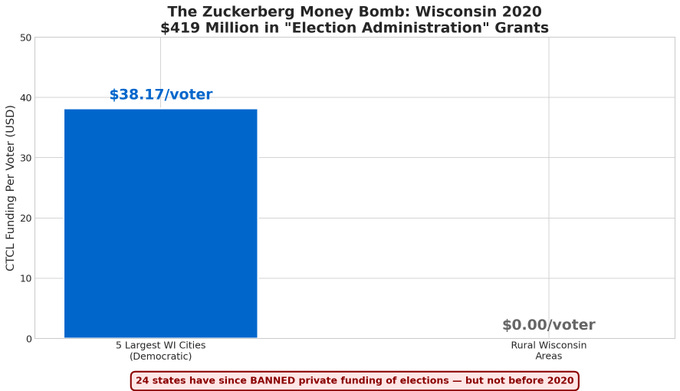
The distribution of that funding did not follow the logic of need or administrative burden. It followed the logic of electoral geography.
In Wisconsin, a battleground state ultimately decided by approximately 20,000 votes, CTCL funding to the five largest cities worked out to 38.17 per registered voter. Those five cities are Democratic strong holds. Rural areas of Wisconsin, which lean Republican, received as little as $0.00 per voter in CTCL funding.
The money funded ballot drop box installations, poll worker recruitment and training, voter outreach programs, and election office operations. These are legitimate election administration functions. The problem is that they were funded selectively, in ways that systematically benefited jurisdictions favoring one party over another.
Election administration in the United States is a government function. Its funding should come from government appropriations, distributed according to administrative need and subject to legislative oversight. When private funding replaces government funding for election administration, and that private funding is distributed according to partisan geographic patterns, the integrity of the administration process is compromised regardless of the intentions of the funders.
At least 24 states passed laws after 2020 banning or restricting private funding of election administration. They did so after the funding had already flowed and after the infrastructure had already been built.
The organizations that challenge election integrity laws operate within the same foundation-funded ecosystem. The ACLU, the Brennan Center for Justice, the NAACP Legal Defense Fund, and Marc Elias’s Democracy Docket organization exist specifically to litigate against laws that tighten election security. They describe voter identification requirements as suppression. They describe signature matching requirements as disenfranchisement. They describe citizenship verification as discrimination.
These organizations have resources to sustain multi-year litigation campaigns across multiple states simultaneously. The funding comes from the same foundation complex that shapes the rest of the infrastructure. The legal strategy is coordinated. The policy narrative is consistent. The capacity is essentially unlimited.
The Brennan Center for Justice has become the primary expert source for mainstream media coverage of voting rights issues. They produce the studies. They train the journalists. They file the lawsuits. They generate the talking points that shape legislative debate. It is a self-reinforcing system: the same organization produces the research that justifies the litigation that produces the policy outcomes that generate the research validating the next round of litigation.
THE MEDIA FUNDING STRUCTURE
American media cannot be accurately understood without mapping its nonprofit funding relationships.
ProPublica, the investigative journalism organization whose reporting shapes national policy narratives on health care, criminal justice, and tax policy, operates on an annual budget of approximately $45 million. Its primary funding comes from the Sandler Foundation, with additional support from progressive foundations. Its investigations consistently advance progressive policy priorities. This is not coincidental. Funders with specific policy objectives fund journalism organizations that produce journalism advancing those objectives.
The Marshall Project covers criminal justice policy exclusively, with funding from progressive foundations including the MacArthur Foundation and the Ford Foundation. Its editorial focus consistently emphasizes decarceration, police reform, and criminal justice system critique. The funding relationship explains the editorial consistency.
National Public Radio and the Public Broadcasting Service receive both federal funding and substantial foundation support. Their coverage reflects a consistent set of policy preferences that align with their foundation funders’ stated priorities.
The fact-checking infrastructure is particularly significant because it operates as a gatekeeper for information on major platforms. The Poynter Institute runs the International Fact-Checking Network, which certifies the fact-checkers used by Facebook, YouTube, and other major platforms to flag or suppress content. Poynter’s funders include the Bill and Melinda Gates Foundation, Google, and the Open Society Foundations.
The organizations that fund progressive policy advocacy also fund the institutions that certify which information is accurate and which information requires a warning label. When the same foundation network funds both the advocacy organizations and the fact-checking organizations that assess claims made by and about those advocacy organizations, the independence of the fact-checking function is structurally compromised.
No external body performs this audit function. No government agency reviews the fact-checking methodology or the funding relationships that might bias it. The system certifies itself.
THE CONSTITUTIONAL PROBLEM
What the data describes is not a conspiracy. No secrecy is required for this system to function. It operates through documented tax filings, public grant announcements, foundation annual reports, and press releases. The information is available to anyone who looks for it.
What it represents is the systematic circumvention of the constitutional order.
The American Constitution establishes that legitimate governmental power derives from the consent of the governed. The Founders designed a system in which every significant exercise of power would face accountability to ordinary citizens, either directly through elections or indirectly through officials who themselves face elections. The system is imperfect. It has always been subject to capture by wealth and interest. But the accountability mechanisms exist, and they have periodically functioned to correct abuses.
The $14.1 trillion nonprofit infrastructure bypasses those mechanisms entirely.
It writes model legislation that state legislators pass without reading. It sues federal agencies into adopting regulations that Congress never authorized. It funds the election offices that count votes. It trains the journalists who shape public understanding of policy debates. It staffs the federal agencies that regulate daily life through fellowship programs and personnel placement. It organizes political pressure campaigns that constrain what elected officials can do. It finances the lawsuits that block the laws those officials pass.
At each step, the power is exercised by unelected, unaccountable organizations that answer to no one except their donors and boards. The donors are often anonymous. The boards are self-selected. The organizations face no meaningful accountability to the public whose political environment they shape.
This is not a republic functioning as designed. It is oligarchy with nonprofit tax status.
The defense most commonly offered is that these organizations do important work, advance worthy causes, and fill gaps that government fails to address. That defense does not engage with the actual problem. The question is not whether any particular cause is worthy. The question is whether unelected, unaccountable organizations should exercise this level of political power in a constitutional republic, regardless of how righteous the cause.
Madison’s logic in Federalist No. 51 does not have a carve-out for organizations with good intentions. Power that is not checked will expand. Power that is not accountable will be abused. These are observations about human nature and institutional behavior, not partisan accusations.
WHAT REFORM REQUIRES
The system described here did not build overnight, and it will not be dismantled quickly. But specific, concrete reforms can address the most significant structural problems.
Radical transparency is the foundation. Every nonprofit organization with annual revenue above $1 million should be required to disclose in real time and on a publicly accessible platform. The donor-advised fund loophole, which currently allows unlimited anonymous political giving through intermediary charitable vehicles, must be closed. Foreign funding of American nonprofit organizations should require complete public disclosure without exception.
The funding-lobbying double-dip must end. Organizations that receive federal grants should be prohibited from lobbying the government that funds them. Taking taxpayer money and simultaneously using organizational resources to lobby for policies that increase that taxpayer funding is a structural conflict of interest. The prohibition should be absolute: government funding or policy lobbying, not both.
The Foreign Agents Registration Act requires enforcement with actual consequences. Currently, only approximately 5 percent of FARA registrants are nonprofit organizations. The law must be expanded and aggressively enforced to ensure that American domestic policy debates are not being shaped by foreign interests operating through domestic nonprofit proxies. The disclosure requirements should apply regardless of organizational structure.
Tax-exempt status should not be permanent. Every nonprofit organization should be required to reapply for 501(c)(3) status every ten years, with comprehensive audits and full public disclosure of activities. The IRS review should specifically assess whether the organization’s actual activities match its stated charitable purpose. Organizations that have functionally converted from charitable work to political advocacy should lose the tax subsidies that charitable status provides.
The sue-and-settle mechanism requires legislative attention. When advocacy organizations sue federal agencies and then settle for consent decrees that impose new regulatory requirements, they are legislating through litigation. They are using the courts to achieve policy outcomes that could not survive the legislative process. These settlements should require Congressional approval before they take effect, or they should be prohibited as a method of establishing binding regulatory requirements.
None of these reforms will be easy to pass. The organizations that benefit from the current structure have vast resources and established relationships with lawmakers, media organizations, and regulatory agencies. They will oppose every reform proposal with every tool available to them. They will describe transparency requirements as attacks on civil society. They will describe lobbying restrictions as threats to free speech. They will describe tax-exempt review as political persecution.
Those arguments should be evaluated against the documented reality of what $14.1 trillion in unaccountable assets actually does to the balance of power in a constitutional republic.
THE ACTUAL QUESTION
Benjamin Franklin’s reported exchange outside the Constitutional Convention in 1787 is worth examining for its precision. A republic, if you can keep it. Not a democracy. Not a free country in the abstract. A republic: a specific system of government in which power is formally accountable to the governed through defined mechanisms.
The American constitutional republic was built on one foundational premise: that ordinary people can govern themselves, and that power should flow from the bottom up rather than being administered from the top down by those who know better and need not answer to anyone.
What the $14.1 trillion nonprofit infrastructure represents is the institutional expression of the opposite premise: that policy outcomes should be determined by organizations with sufficient resources to fund the legislation, staff the agencies, train the journalists, litigate the courts, and organize the political pressure that makes those outcomes happen. The voters can register preferences. The infrastructure determines results.
The question is not ideological in the conventional sense. It is constitutional. It is about whether the formal structure of self-government still means what the founding documents say it means, or whether it has become an elaborate procedural facade over a system of power that operates according to entirely different rules.
The data says the infrastructure is real. The funding is documented. The mechanisms are operational. The political consequences are measurable.
The only remaining question is whether enough Americans, across whatever political differences they hold, still consider accountable self-government worth defending. If the answer is yes, then the work of reform is specific, concrete, and available to begin immediately. If the answer is no, then at minimum we should be precise about what we have permitted to happen and stop describing it with words that no longer apply.
$14.1 trillion. Zero votes. The accounting is straightforward.
What comes next depends entirely on whether you find that arrangement acceptable.
Margin of the Law publishes constitutional analysis, civic research, and legal education for people who want to understand the system they actually live in. Read the Full Constitutional Analysis Library at marginofthelaw.com.
© 2026 – MK3 Law Group
For republication or citation, please credit this article with link attribution to marginofthelaw.com.