
By Malcolm Lee Kitchen III | Margin Of The Law
The System Behind the Cameras
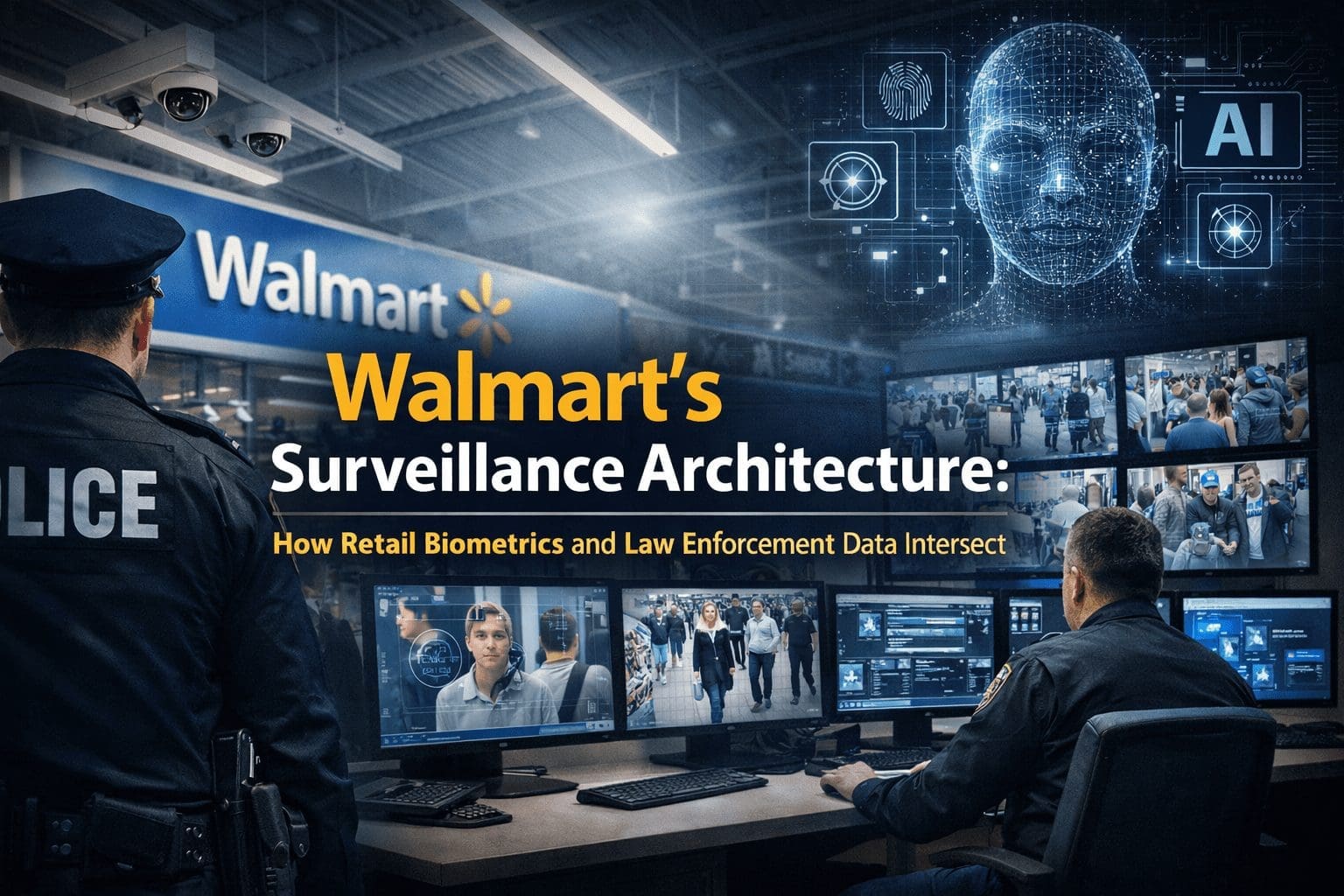
Walmart operates one of the most sophisticated surveillance infrastructures in American retail. What shoppers encounter is not simply closed-circuit television monitoring aisles for theft. The network is an AI-integrated data fusion system that combines computer vision, behavioral analytics, loyalty program information, and wireless device tracking into a unified surveillance apparatus.
The technical components work together. Computer vision systems, including technology from Everseen and historical data connections to Clearview AI, perform visual analytics for what Walmart calls “Missed Scan Detection” at checkout stations. Behavioral profiling algorithms identify patterns across self-checkout interactions, customer movement through store sections, and return transaction behaviors. Purchase data integration links transactions to individual identities through partial identifiers including facial geometry measurements, gait recognition signatures, and, in some locations, voiceprint analysis from audio monitoring systems.
Cross-device correlation adds another layer. Customers who never log into Walmart’s network can still be tracked through unique smartphone radio frequency fingerprints or MAC address hashes captured by in-store WiFi infrastructure. This allows the system to monitor movement patterns across multiple store visits without requiring any voluntary identification from the customer.
The business model becomes clearer when examined through this lens. Product sales represent the visible commerce layer. The less visible operation involves data monetization and behavioral analysis at scale. Walmart’s Privacy Notice, updated December 2025, reflects this expansion by including explicit references to “virtual apparel try-on tools,” terminology that describes biometric body mapping capabilities. These are not incidental features. They are architectural expansions of a data collection system that treats every customer as a source of extractable information.
Physical Camera Infrastructure
Documentation from the University of Illinois Founders blog published in December 2025, along with corroborating industry sources, describes the physical scope of Walmart’s optical surveillance. Entrance and exit points, high-value merchandise aisles, pharmacy sections, service counters, and refrigerated food displays operate under active camera monitoring.
A typical Walmart Supercenter contains more than 500 interior cameras. Additional exterior cameras, including license plate recognition systems, monitor parking areas and building perimeters. Coverage extends to nearly every aisle, with concentrated attention on electronics, cosmetics, and over-the-counter medication sections where theft rates and product values are highest.
Camera hardware typically uses dome or pinhole configurations, networked through private fiber connections or Walmart’s internal WiFi infrastructure. Identified technology vendors include Bosch, whose Flexidome IVA systems appear in documented deployments, and Everseen AI for analytics processing. Independent verification comes from IPVM reporting between 2015 and 2019, along with Security Vision industry documentation confirming these installations.
This is not passive security infrastructure. The cameras feed active analytics systems that process what they observe in real time. The distinction matters because passive recording and active biometric analysis represent fundamentally different relationships between a retailer and its customers.
Historical Development: From Deterrence to Biometric Collection
The evolution of Walmart’s surveillance capabilities follows a clear trajectory from visual deterrence toward active biometric data capture.
In 2015, Walmart conducted pilot programs testing facial recognition across multiple states to identify repeat shoplifters. The technology likely involved FaceFirst systems. These programs were eventually discontinued due to insufficient return on investment, not because of privacy concerns or legal pressure.
Between 2017 and 2019, the company deployed Missed Scan Detection systems using Everseen AI and computer vision cameras. This technology monitors checkout stations for items that pass scanners without being recorded. These systems currently operate in more than 1,000 stores and continue expanding.
The year 2020 brought significant public attention when BuzzFeed reported that Walmart employees had maintained Clearview AI accounts, conducting nearly 300 facial searches through the platform. This practice ceased following an ACLU settlement that prohibited Clearview AI from selling its services to private corporations in Illinois.
Legal challenges emerged between 2022 and 2023 when BIPA lawsuits were filed, including cases handled by Milberg Law in Illinois. Plaintiffs alleged that Walmart collected facial and biometric data without obtaining written consent as required under state law. These cases remain in active litigation.
Current deployments from 2024 through 2025 show the reintroduction of emotion recognition and behavioral analytics systems. While technically distinct from facial recognition as traditionally defined, these technologies derive tracking data from the same biological characteristics. Walmart patent filings describe capabilities for “disgruntled customer detection” that identify shoppers displaying negative emotional states to alert management personnel.
The important distinction here involves terminology rather than technical substance. When Walmart states it “stopped facial recognition,” the company pivoted to Emotion AI, gait analysis, and pattern recognition systems. These technologies still process facial geometry vectors. They simply operate under different product labels in corporate communications. The data collected is functionally equivalent. The branding is not.
Data Retention Practices
Multiple sources including Facia.io and 33rdSquare provide information on how long Walmart stores surveillance data.
Standard video retention periods range from 30 to 90 days under normal circumstances. Locations experiencing higher crime rates retain footage for 6 to 12 months. Supercenters may keep video archives for up to one year. Smaller format stores typically maintain recordings for 14 to 60 days.
These timeframes apply to video footage. Biometric templates, the mathematical representations of facial features, body measurements, and movement patterns, operate under different rules. These derived data products can persist indefinitely in analytical archives even after corresponding video files are deleted. Because these templates constitute processed data rather than raw video, most privacy notices do not specifically address their retention periods. Walmart’s privacy notice is no exception. The company discloses video retention. It does not disclose biometric template retention in terms that would allow a customer to understand how long their facial geometry remains stored in corporate systems.
The Cash Purchase Identification Problem
Reporting from Daily Dot in December 2025 documented instances where customers received personalized feedback emails from Walmart after completing cash purchases without carrying mobile phones into stores.
These customers paid in cash using no digital payment methods. They did not carry smartphones that could provide wireless identification. Yet Walmart correctly identified them and contacted them through email addresses associated with their accounts.
The only technical explanation involves facial matching against previously collected customer data. Prior purchase histories, email addresses from loyalty program registrations, or previous checkout interactions where identification occurred would provide the database entries. Current camera systems then matched faces observed during the cash transaction to those historical records.
Customer and employee commentary on social media platforms responding to these reports stated directly: the company uses facial recognition to link anonymous transactions to identified customer profiles.
This represents the practical application of biometric matching as a replacement for traditional loyalty card identification. The system creates connections between physical presence in stores and digital identity records, mapping facial characteristics to email addresses, social media profiles, previous application usage, and wireless device presence data. A customer who believes they are making an anonymous cash purchase is, in practice, making an identified transaction. They simply were not informed of that fact.
Legal Framework and Exposure
Illinois enacted the Biometric Information Privacy Act, creating the only significant legal framework giving consumers private rights of action regarding biometric data collection. BIPA requires three specific protections.
First, companies must provide notice and obtain written consent before collecting biometric information. Second, the purpose and retention period for collected data must be clearly disclosed. Third, published schedules for data deletion must be maintained.
Walmart faces allegations of violating all three requirements.
The financial exposure is substantial. Successful plaintiffs under BIPA can recover between 1,000and1,500 per violation. Applied across millions of store visits by Illinois residents, potential liability reaches into billions of dollars.
Outside Illinois, most American states provide no equivalent protection. Residents in these jurisdictions have essentially no legal recourse against biometric data collection without consent.
The mechanism that provides legal cover for these practices involves signage posted at store entrances. Fine print stating “By entering, you consent to security monitoring and analysis” transforms the entire surveillance apparatus into permissible “loss prevention” activity under current legal interpretations. That framing does not distinguish between recording video of a parking lot and capturing facial geometry for indefinite storage in biometric databases. The consent language is written broadly enough to cover everything. Customers are not informed of what they are consenting to in specific terms.
Confirmed and Suspected Technology Components
Documented and reasonably inferred technologies operating within Walmart’s surveillance ecosystem include several distinct systems.
Everseen AI provides real-time theft and missed-scan detection through neural network processing of checkout camera feeds. Clearview AI connections, while officially discontinued, created historical exposure through facial matching across public image databases. Emotion AI capabilities, documented through patent filings, identify faces displaying negative emotional states and generate management alerts.
Radio frequency and WiFi cross-matching enables device re-identification through consumer MAC address correlation. Smartphones and other wireless devices broadcast identifiable signals that can be tracked across store visits without any active connection to store networks.
Walmart+ membership and virtual try-on features capture three-dimensional body scans stored in user accounts. This capability was documented in Walmart’s privacy notice and RetailDive reporting from 2022. License plate analytics systems monitor parking areas and create connections between vehicle identification and digital receipt records.
The combined effect is a comprehensive fusion of biometric, behavioral, purchase, and network-level tracking operating continuously across thousands of locations. Each individual component might seem defensible in isolation. Together, they constitute a surveillance infrastructure with few equivalents in the private sector.
Structural Implications for Consumer Privacy
The Walmart model exemplifies what researcher Shoshana Zuboff termed the Extractive Surveillance Economy. Walmart’s particular advantage over purely digital surveillance operators involves physical ubiquity. Nearly every American resident lives within 15 miles of a Walmart location.
This geographic coverage positions the company to potentially become the largest holder of real-world biometric data outside government systems. The scale exceeds banking institutions and may surpass federal law enforcement for practical population coverage.
Even if Walmart does not directly sell biometric data to third parties, the company almost certainly cross-references collected information through marketing partnerships and AI training applications. These uses operate outside consent frameworks because processed data receives “anonymized” classification.
The anonymization claim deserves scrutiny. Biometric embeddings, the mathematical representations of facial features, function as deterministic identifiers. A face hash that can identify someone in a store can be compared against publicly available photographs to reverse the anonymization. The process is technically straightforward when sufficient comparison images exist. Calling these embeddings “anonymized” is a classification that serves legal convenience rather than technical accuracy.
Law Enforcement Integration: The Warrant Question
The question of whether Walmart’s systems can identify individuals with outstanding warrants requires careful analysis of both legal restrictions and practical capabilities.
Walmart’s documented surveillance software, including Everseen AI, historical Clearview AI connections, and internal analytics systems, creates biometric embeddings designed primarily for loss prevention rather than direct warrant verification. No corporate or legal records indicate Walmart runs live queries against NCIC (National Crime Information Center) or state warrant databases. Federal law restricts such access to authorized law enforcement agencies.
However, data sharing pathways create functional equivalents to warrant detection without direct database access.
Law enforcement portals and subpoenas represent the most direct connection. Walmart’s Asset Protection Division maintains working relationships with police task forces. Officers routinely obtain footage or facial data from store systems through formal requests.
Third-party analytics vendors create more significant exposure. Companies including Clearview AI sold identical software packages to both retailers and police departments. When both customer categories use the same platform, facial templates can match across the vendor’s servers regardless of formal database access permissions. This creates indirect connections through shared infrastructure.
Watch list uploads from local police represent another pathway. In certain jurisdictions, law enforcement agencies provide still images of wanted suspects or persons of interest to retailer networks under community partnership programs. Store cameras then generate alerts when facial matching identifies someone from these lists.
The Vendor Intermediation Architecture
The technical structure that enables quasi-warrant detection operates through vendor intermediation. Retailers and law enforcement agencies use the same commercial AI vendors. Those vendors host shared databases or cloud-based application programming interfaces.
Rather than Walmart querying federal databases, which would be illegal, store camera feeds transmit to vendor cloud systems. Those same vendor systems hold or synchronize data from law enforcement watchlists. The vendor performs matching operations and sends alerts back to each client category separately.
This architecture creates a legally deniable yet operationally complete surveillance loop. Each participant performs only their specific function, so no single entity violates data sharing restrictions. Chained together, the system functions as a turnkey warrant recognition capability.
The data flow operates through several stages. Store cameras record incoming customers. Each face undergoes local analysis and conversion into numeric facial embeddings. These vectors transmit to vendor APIs typically hosted on major cloud platforms. Vendor systems simultaneously compare incoming vectors against retail internal databases of known shoplifters, police-contributed datasets provided under partnership agreements, and publicly scraped datasets from social media and mugshot repositories.
When similarity scores exceed configured thresholds, vendor systems notify store dashboards of potential matches including confidence levels. Store personnel observe flagged individuals and contact local police. If officers confirm active warrants, arrests follow.
The legal structure maintains plausible deniability at each stage. Biometric data processing occurs through private vendors not bound by retailer privacy laws or law enforcement access controls. Warrant and mugshot linking happens at the vendor level using data “shared by third parties” rather than “queried by the retailer.” Alerting operates automatically under loss prevention policies. Arrests proceed based on “tips from cooperating citizens.”
Transparency Deficits
Walmart’s privacy notice does not disclose that biometric data may be checked against external law enforcement repositories. Walking into a store under signage referencing “loss protection” does not constitute informed consent to facial searches against police watchlists.
The arrangement effectively deputizes corporations as data collection extensions of law enforcement without corresponding accountability structures. Law enforcement agencies operating directly are subject to constitutional constraints, oversight mechanisms, and legal challenges. Private corporations operating through vendor intermediaries are not subject to the same constraints. The practical result is that surveillance capabilities that would face legal scrutiny if operated directly by government agencies can be deployed through corporate infrastructure with minimal restriction.
Facial vectors persist in vendor networks indefinitely regardless of whether the person ever committed any theft. The databases grow continuously. Retention policies, if they exist, operate without public disclosure or independent oversight.
Consumer Protection Strategies
Individuals concerned about biometric surveillance collection have several practical options for reducing exposure.
Wearing hats or masks where permissible disrupts facial recognition accuracy. Walmart has not prohibited face coverings since pandemic-era policies normalized their presence in retail environments. Sufficient occlusion of approximately four percent or more of facial features triggers uncertainty in most matching algorithms.
Avoiding loyalty program or rewards code scanning in stores prevents the connection between facial observations and identified digital accounts. This represents the critical link that enables systems to associate anonymous physical presence with named customer records. Separating your physical presence from your digital identity in these environments limits what the system can build around your profile.
Cash payments and minimized time in front of self-checkout cameras reduce the quantity and quality of facial data available for capture. Checkout stations represent primary collection points where cameras have optimal angles and lighting for biometric extraction.
Illinois residents can leverage BIPA protections by filing formal inquiries regarding biometric handling practices under Section 15(a-c) of the statute. This creates documented records of company responses that may prove relevant in enforcement actions.
Walmart’s Privacy Rights Request process, documented in their 2025 privacy notice, provides a mechanism for requesting personal data the company holds. While responses may be incomplete, the process creates records of what information the company acknowledges possessing.
Photographing fine-print signage at store entrances provides evidence regarding what consent claims the company makes. This documentation matters in cases where the scope of claimed consent becomes legally contested.
The Broader Pattern
What operates within Walmart represents a template applicable across the retail sector. The combination of ubiquitous cameras, advanced biometric analytics, cloud-based vendor services, and informal law enforcement data sharing creates infrastructure that fundamentally alters the nature of commercial spaces.
The implicit transaction offered to consumers involves exchanging lower prices and shopping convenience for comprehensive identity tracking. The terms of this exchange receive no explicit disclosure. Most shoppers remain entirely unaware of the data collection occurring during routine purchases.
If retail surveillance normalizes ubiquitous biometric capture under loss prevention justifications, the implications extend beyond shopping. The technology, once deployed and refined in commercial settings, becomes available for application across any physical space where cameras can be installed.
The constitutional framework of this republic assumes citizens maintain reasonable expectations of anonymity in public spaces. Pervasive biometric identification, even when technically legal, erodes the practical foundation of that assumption. Identity becomes something tracked continuously rather than disclosed voluntarily. The right to move through commercial spaces without being identified, catalogued, and cross-referenced against law enforcement databases is not a right that currently receives meaningful legal protection in most American states.
Legislative responses exist but remain geographically limited. Illinois stands alone in providing meaningful private enforcement rights. Replication of BIPA-style protections across additional states would change the regulatory landscape. Until that occurs, the surveillance architecture continues expanding with minimal constraint.
The infrastructure exists. The technical capabilities are proven. The legal frameworks that might restrict their application remain underdeveloped in most jurisdictions. What happens next depends on whether public awareness translates into political pressure sufficient to establish meaningful limits on corporate biometric surveillance. That outcome is not guaranteed. The companies benefiting from the current framework have significant resources and strong incentives to prevent legislative change. The people subject to this surveillance have rights that have not yet been codified into law in most of the country. That gap is where this system operates, and it has been operating there for years.
Margin of the Law publishes constitutional analysis, civic research, and legal education for people who want to understand the system they actually live in. Read the Full Constitutional Analysis Library at marginofthelaw.com.
© 2026 – MK3 Law Group
For republication or citation, please credit this article with link attribution to marginofthelaw.com.